"Once," said a sagacious old woman, "we looked towards Laos for the joys of film. That's the way they came to this part of Thailand. From China southwards the films came, down old trade routes through Laos, into Isan."

The period that Grandma Yamjid (pictured above) was referring to was the 1920's and 30's, when China was one of the few East Asian countries to have a well established film industry. Thailand -- then Siam -- apparently wasn't distributing it's films too far outside of Bangkok in those days, let alone the 600-odd kilometers to the tiny border post of Nong Khai, which was then mostly sugarcane fields. Enterprising Chinese traders filled that market niche by sending the coveted motion picture reel south into Laos, northeastern Thailand (Isan) and points beyond, spreading popular Chinese culture along the way.

In the late 1960's, after Grandma Yamjid and her husband had inherited the old wooden theater that her parents built decades before -- Nong Khai's original movie theater -- the Thai government passed legislation outlawing wooden movie theaters. They were considered fire hazards. In response, Grandma Yamjid and her husband built the
Thepbanterng Theater, which opened in 1970. Thepbanterng is the family name.
 The Thepbanterng Theater: a Nong Khai staple since 1970, now vacant save for the internet shop in the lobby.
Grandma Yamjid was full of stories of from her days as operator of the
Thepbanterng Theater. In the early 1970's American CIA agents were trying their darnedest to undermine the communist insurgency across the river in Laos. Grandma Yamjit recalled renting out the entire top floor of her family's Thepbanterng Hotel, which was in front of the theater, to CIA agents. American military personnel spent a portion of their R&R in the soundtrack room of the
Thepbanterng.
 The Thepbanterng is boxed-in in a narrow court, making it hard to photograph in its entirety and beckoning me to invest in a wider angle lens.
 For 39 years the blazing Isan sun has faded the lettering on the Thepbanterng's sign. My over-exposed photo didn't help things.
 Portraits of the king and queen still hang over what used to be the ticket booth.
 The auditorium held 1,200 seats, with tickets for upper level seating going for 10 baht per show, and 5 baht for seats down below.
 If it was a packed house, the Thepbanterng had reserve of several hundred folding seats like this one to be placed in the aisles.
 The third level of the theater featured a soundtrack room, built to accommodate the many American service personnel that were living in and around Nong Khai in the early 1970's. This room would play the original English language soundtrack, as Hollywood films were otherwise dubbed in Thai.
 The box in the above photo covered a staircase that led to a "Smoking Room," where viewers could get their tobacco fix without missing the film or bothering non-smoking viewers. They watched through the window above.
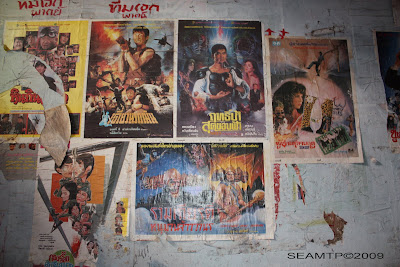 Movie posters adorn the wall in the basement, which was used as a changing room for theater employees.
 Grandma Yamjid's daughter, Waew, grew up with the family theater as a glowing backdrop to her childhood. She now runs an internet business from its lobby.
The Thepbanterng Theater closed it's doors for good during the 1997 Asian financial crisis.
-------------------------------------------------------------------------------------------------
If it's true - and I have no reason to believe otherwise - that wooden movie theaters were banned in Thailand in the late 1960's, that plugs some gaps in my understanding of the Thai theater industry. Just about every single-screen theater I've come across in northern and northeastern Thailand was built in the late 1960's or early 70's, filling the void left behind by the destruction of the old wooden theaters, as propagated by Thai law. That partly explains why in northern Thailand and Isan it's also difficult to find a theater that pre-dates the 1960's, even though films have been screened in these parts since well before then.
(It was a great joy and honor to speak with Grandma Yamjid and her daughter, Waew. Many thanks to them both for their kindness and keen memories).


