Showing posts with label Myanmar - Bago Division. Show all posts

Sunday, April 21, 2019

The Aung Mingala Cinema - Nyaunglebin, Bago Region, Myanmar

On the opposite end of town from the YMBA Cinema - a straight shot if you follow to the street parallel to the train tracks - is old Nyaunglebin. This section of town flourished in the heyday of train travel. The British-built system that slinks its way across Myanmar was at the forefront of the modern market economy when it opened - piecemeal, one section at a time - in the early 20th century. To this day, town centers in many secondary and tertiary cities are at their most elegant near the train station, reflecting the economic heft carried by the locomotive.  

Nyaunglebin fits that mold. From the faded elegance of the train station, the town's produce hawkers begin their serpentine rows down the sidewalks, their fresh fruit and veggies displayed in sprawling piles in front of them. Behind them stand the rows of architectural treasures; ornate old buildings, largely intact, but so badly neglected that they appear as slumping, brittle shadows of their former selves. 

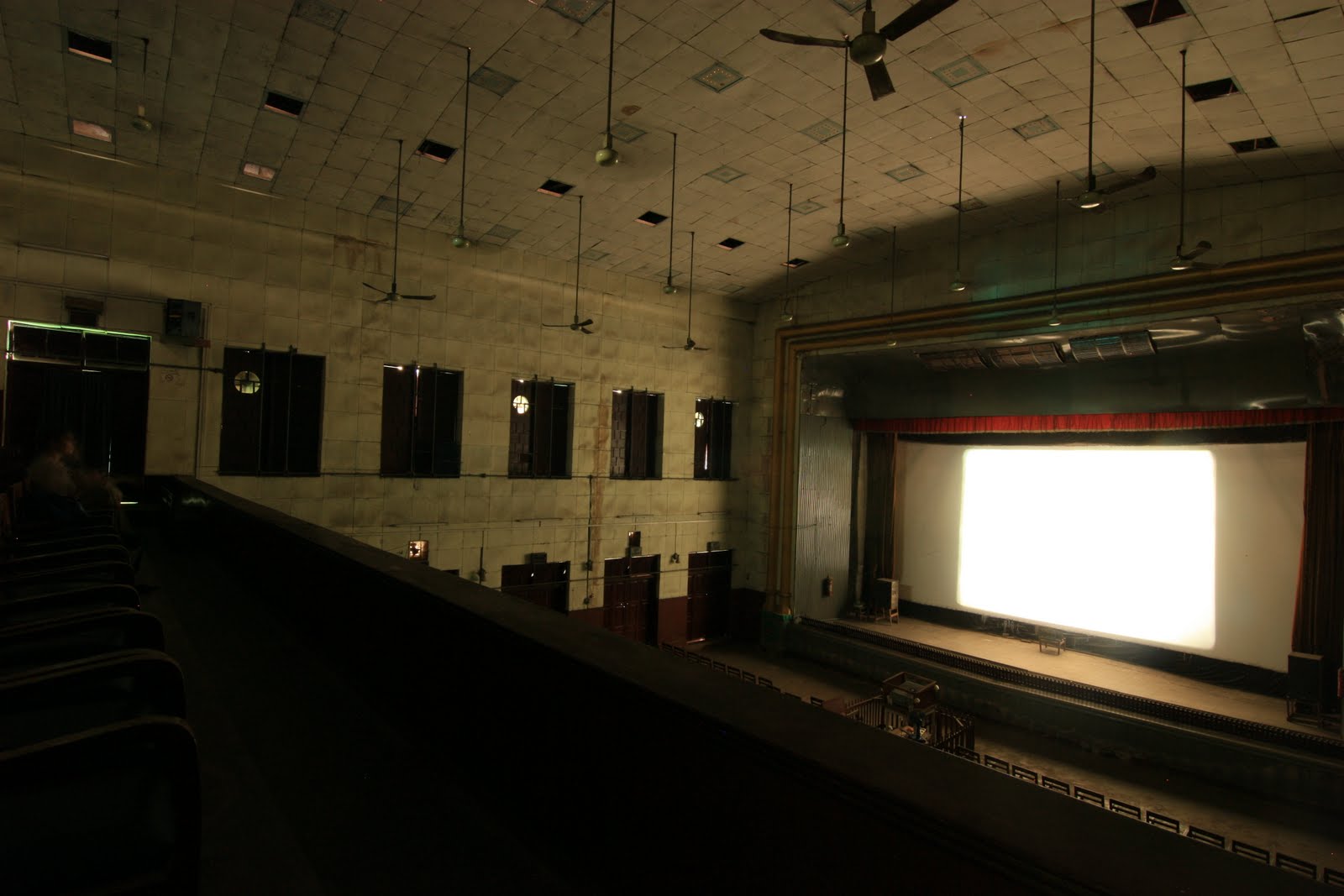
Among this collection of vintage structures stands the Aung Mingala Cinema. Unfortunately, the exterior of the Aung Mingala was so far gone from modifications and neglect that photographing it would have been a futile effort. The interior, too, didn't have much to offer, except for a few hand painted flourishes on the proscenium, which are displayed below.


Abandoned auditorium of the Aung Mingala Cinema


A hand painted Zatt Minn Thar, or traditional Myanmar actor/dancer, flanks both sides of the wooden proscenium at the Aung Mingala Cinema 


The Zatt Min Thar


A painted Ga Lone figure, enemy of dragons, serves as a simple crest above the screen.


Looking back towards the projection booth and balcony seating. 

It's minutia like this that offers flickers of a forgotten past that will almost definitely be erased in the years to come. 

Friday, March 8, 2019

The Young Men's Buddhist Association Cinema Hall - Nyaunglebin, Bago Region, Myanmar

The Young Men's Buddhist Association has a storied history in Myanmar. Founded in 1906 to promote Burmese Buddhist values during the height of British colonial rule, the organization was an early incubator of the anti-colonial movement. It was at the insistence of YMBA members that the "footwear controversy" - a long-running debate between the Burmese Buddhist clergy and British officialdom over the practice of removing ones shoes when entering Buddhist sites (the Brits didn't expose their funky toes) - was pushed into the political sphere. Eventually the offending British were forced to capitulate, marking an important victory - if only symbolic - for the oppressed over the oppressors.

Despite the sectarian ring to its name, the YMBA had no formal connection to the then fractious Buddhist clergy. In practice, its function was much in line with its Western counterparts the YMCA and YMHA - social clubs based on religious affiliation, sans religiosity.  


A simple metal gateway to the right of the YMBA office once marked the way to the YMBA Cinema. The sign now advertises the YMBA football pitch, but in years gone by it was festooned with movie ads. 

The Nyaunglebin branch of the YMBA - founded in 1962 - was the only one in the country to ever have a purpose-built movie theater. The reason for this unusual coupling speaks volumes to the progressive nature of the organization, if not the local founder. 

Unlike other branches of the association, which depended for their survival on outside donations, the founder of the Nyaunglebin branch was intent on it being self-sustaining. This was as much a political sentiment as it was an act of entrepreneurship. His logic was to keep at bay those who sought to gain sociopolitical influence by donating money to a quasi-religious institution - an upstanding statement given the political climate of the times. Post-colonial Burma was a budding democracy. In so being, it was a highly divided and fractious society, in which money could go a long way politically. It was this state of affairs which ultimately and decisively came to an end with General Ne Win's military coup of 1962.

The YMBA Cinema was in essence the answer - at least in Nyaunglebin - to the day's political corruption.


Molded concrete signage is a common feature among on many early to mid-century buildings in Myanmar. The gold paint here adds a little bit of pizzazz. 

The building pictured in the two photos above, however, is not actually the YMBA Cinema. It's the head house of the larger YMBA complex, which includes the former cinema. This handsome building, which fronts onto the busy Old Yangon-Mandalay Highway, contains the office and meeting hall on the 2nd floor, with retail space (another way of raising funds) on the ground level. The cinema is located in an adjacent building just behind the office.


The logo for the YMBA symbolically situated above its founders on the office wall.


The YMBA Cinema was accessed by a long corridor on the side of head house. The cinema is now closed, but has since been transformed into a football pitch. 

Some ten years ago, the Nyaunglebin YMBA closed down the movie theater. Dwindling attendance was the main culprit. Keeping true to the YMBA community spirit, the large hall was converted into a football pitch, complete with AstroTurf. That's how I found it this past January. 


Teak wood theater seats, left overs from the days of cinema, are piled up at the far end of the hall.


From film to football - or soccer, for my American readers. This view depicts holes for the projectors flanked by balcony level seating.


Looking towards where the screen used to be.


Friday, October 5, 2018

The Myoma Cinema - Letpadan, Bago Region, Myanmar

Letpadan had not been on my radar until early 2016, when, while at a photo exhibition in Yangon, I saw some shots of university students clashing with police there from the year before. Those images were the first I'd heard of the town, leaving me with an impression of a contentious little place full of disaffected youth and brutish cops.

Later on, a few older Myanmar friends mentioned that Letpadan was once a fairly important trading center, if not the primary town of Myay Latt - Myanmar's version of the English Midlands - an agriculturally rich area running northwest from Yangon up to the lower Dry Zone. Any place with that kind of clout, I reasoned, was bound to have had some movie theaters. 

Those suspicions were confirmed during last February's "Theater Hunt." Ledpadan is indeed home to two old movie theaters - The Myoma and Aung Mingala cinemas. Both share a similar architectural footprint and stand directly next to each other just off of the city's main traffic circle. Together they comprise what must have once been the commercial center of the town, with their broadside girth dominating the the low rise townscape.


The Myoma Cinema stands in the background on the left. The freshly painted Aung Mingala Cinema stands on the right. 

From the exterior, The Myoma Cinema has the appearance of a brick and mortar dignitary with a skin condition. One that could be easily remedied with a scrubbing and fresh coat of paint.  Nevertheless, The Myoma radiates an old-school charm despite its crumbly worn facade. 

The theater itself, which was located on the second and third stories of the building, has been closed for over a decade. But the shops that occupy the ground level portion of the structure, each situated in its on little nook behind the arcades, make the dormant theater lively even in its under-utilized state.   


The Myoma Cinema, dating to 1959, one of the more interesting buildings in Letpadan.


In an offhand way, The Myoma and other similarly designed movie theaters were the forerunners to the contemporary multiplex-shopping mall combo that make so much of urban Southeast Asia into an air-conditioned nightmare today. Retail space on the lower levels, movie theater on the top. Sadly, the new architecture of convenience tends to lack the human scale charms present in buildings like The Myoma, which are slowly being lost across the region with each passing year.

I can only image the time capsule of an auditorium, with its wood-worked balcony and hand-crafted ornamentation, all boarded up on that second level, but nobody seemed to have the key for it. Lucky for me, the Aung Mingala Cinema next door had a well preserved second level, which I was kindly granted permission to photograph and has an auditorium which I would guess approximates the Myoma's. Guess you'll just have to wait for the next post to see. 


Sunday, January 28, 2018

A Route to Myanmar's Movie Theaters

For the third consecutive year, ye olde Myanmar map will be put to good use.  From my starting line in Yangon, I plan on moving in a northwesterly direction up through Western Bago and then zig-zag  my way across Magwe, Mandalay and Sagaing Regions. Barring any holdups, the survey should end in either Myitkyina, Bhamo or Kalay before heading back down to Yangon by the 21st of February. I will try to squeeze in as many towns and their respective movie theaters as possible in a northerly race against a three-week time limit.


First stretch of the theater hunt. 


Dry Zone theater hunt route


Upper Myanmar theater hunt route

If all goes as planned I will get severely ill - possibly from food poisoning - lose some weight I can ill afford to lose, and maybe suffer a burn or two during this expedition. I will get diarrhea. Dehydration will get me once or twice. I will vomit. The civilian informants and local gendarmes who chased me out of Natmauk - General Aung San's birthplace - and Thandwingyi in 2011 will have hopefully found more useful things to do. I am bracing myself for the inevitable night at a flea bag hotel with mosquitoes, bed bugs and/or carpet beetles. I am bracing myself for the inevitable town with no hotel at all, or no licence to host foreigners. Strange skin irritations will come as no surprise. In the Dry Zone cities, I am prepared mentally to have a few unpleasant encounters with raging ethno-nationalists. I will try not to drink too much Myanmar Beer. I will forget to exercise. Loneliness followed by bouts of mild depression will creep up on me. I will photograph lots of old movie theaters. In the end, barring catastrophe, I will be smitten with Myanmar as usual.

You can follow me on Instagram and Facebook which I will be updating regularly while on this survey.


Thursday, October 19, 2017

A few more of Myanmar's cinema treasures back in business

Before you write off the stand-alone movie theater in Southeast Asia as a dying form from last century, take a look at Myanmar.

Mingala Cinemas, the largest cinema exhibitor and distributor in the country, has been on a tear of late acquiring and refurbishing defunct old movie theaters nationwide. Over the past 3 years they have expanded their holdings beyond their traditional mainstays of Yangon and Mandalay, moving into second and even third tier cities across the country.

Mingala's most recent reopening occurred last week with The Shwe Hintha Cinema in Bago, which a few historically-minded locals claimed is one the oldest existing theaters in the country. The single-screen Art Deco movie hall, situated at one of the cities primary intersections, is now back to screening films on a daily basis following a few years hiatus.


A few shots of the Shwe Hintha Cinema c. 2010, before it closed down.


Plaster work signage of the Shwe Thintha. The name translates to Golden Brahminy Duck, which is the symbol of the Mon people, who founded the city centuries ago. 

But the good news doesn't stop there. A representative from Mingala Cinemas recently announced that renovations have commenced at their most recent acquisition, The King's Cinema of Mawlamyine, Mon State. 


The King's Cinema of Mawlemyine, the most recent acquisition of Mingala Cinemas, currently undergoing renovations


The famous sail sign on the front corner of the King's Cinema


The 72-year old "proto" Brutalist cinema hall, with its signature tiled sail sign facing onto the Salween River waterfront, has been out of operation since 2012. Its reopening will be a welcome addition to Mawlamyine's slow-moving renaissance and a valuable move in the realm of architectural preservation.  

Highly capitalized movie exhibitors aren't usually in the business of preserving historic movie theaters. Especially not in Southeast Asia, where historic preservation gets little traction to begin with. But Mingala Cinemas is doing just that. The company is equally committed to sustaining decades old landmarks as they are to growing their business. In an age of rapid development and the casting off of the old for the new, Mingala's approach to expansion is a breath of fresh air. 


Thursday, September 15, 2011

The Tun Thiri Cinema - Pyay, Bago Division, Myanmar

Being pushed from Magwe's towns and cities, one after another, was reason enough to depart the dust choked division, with its xenophobes and zealous police force. We caught a bus south to the biggest city of western Bago Division - a bustling town hugging the banks of the Irrawaddy called Pyay.

There couldn't have been a better town to conclude January's Myanmar movie theater search than Pyay. Its collection of ornate buildings from the colonial days onward, crowning a city plan of gridded streets, offered visual intrigues at ever turn. The townsfolk, moreover, were nothing but welcoming, in stark contrast to the inhospitality we'd just departed in Magwe.

But the cherry on top of all Pyay's goodness is its lone cinema hall. The last of a purported four that once enriched the city's cultural life, the Tun Thiri Cinema is a surviving gem from an era when movie theaters were built with pride and high craftsmanship. Locals dated it to about 1960.

Typical of Myanmar movie theaters built during the independence era, Art Deco was employed in the Tun Thiri's design.

Through the trees.

Facade angles


Out-door ticket windows.

The ticket booth in the lobby. Each opening and its corresponding ticket seller represents a different price ticket. 500 Kyats, 800 Kyats and 300 Kyats.

Though clearly showing its years, the Tun Thiri Cinema has an elegance to it that is fairly common among Myanmar movie houses, of which the stand-alone variety reigns supreme. Their prevalence, however, is likely to decline as regional and global economic integration sends ripples of change through the country. In Myanmar, the age of the shopping mall is closing in, with multiplex monotony right on its heels. In the below passage, the Myanmar Times has detailed the openings of two new multiplex mini-theaters in Yangon, an event which could have grave implications for the country's stand-alones:

"WHEN Junction Maw Tin Shopping Centre opened last year in Yangon, on the corner Anawrahta and Lan Thit streets in Lanmadaw township, the facilities included Junction Cineplex, consisting of two small cinemas.

Taw Win Centre, which opened on Pyay Road in February, followed suit with three small cinemas of its own. Two are already showing Myanmar movies on DVD, with plans to open the third, equipped to show 3D movies, in October.

Thus has the modern mini-theatre, capable of holding no more than 200 audience members, been introduced to Yangon." FULL ARTICLE

Proscenium gold

Audience abstractions

View from the balcony during showtime.

Sparseness

Manager and ticket booth

Stills

The Tun Thiri's trusted "theatersmith," a staple of the business for many years.

Signage

The Tun Thiri Cinema closes out the catalog from my most recent trip to Myanmar - a theater which was indeed a grand finale to a great expedition. All said, there are still many towns and cities in Myanmar which I have yet to explore, a task I relish to undertake in the months ahead. But I have a sneaking suspicion that those theaters yet unseen will remain so into the foreseeable future. Hopefully they will be alive and well when the chance to document them comes again.

Monday, October 18, 2010

The Win Cinema - Toungoo, Bago Division, Myanmar

If, as it states in the Bauhaus school of architecture's manifesto, "the ultimate aim of all creative activity is the building," then it is only natural that the movie theater represents the height of creative function. What else can be expected when combining the "ultimate aim [in] creative activity" with the most dynamic of all the visual arts, film? By this definition the movie theater ought to be the most interesting building in town.

The Win Cinema, one of many elegant art deco cinemas in Myanmar.

I regret not putting the above theory to the test in Toungoo, where aside from a pilgrimage to the town's lone remaining movie theater, I did little exploring. One thing I did pick up on, however, was that the ethnic diversity; the melting-pot qualities typical of cities in lower Myanmar were absent up here. I was closing in on the central dry zone, cultural breadbasket of the Bamar (Burmese), where I found immediate solace in the Win Cinema.


Cut-out lettering on the pitch of the facade.

Show times beside the entrance

The ticket stand, concessions and entrance to the auditorium are accessed down a narrow corridor along the far left hand side of the Win. Movie posters are tacked to the wall and bicycles belonging to Win patrons and employees line the perimeter. Prior to show time, this is where everybody had congregated to chat and examine the posters on the wall.

Bikes and posters

Man buys ticket

Lining up

Tickets and their sellers

Concessions were sold by this woman and her husband. The couple arrived about 20 minutes before showtime, set up their products, sold a few things, and then packed up and left once the show started.

Usher sits next to auditorium entrance.

Wooden benches make up seating options on the first level.

Looking towards rear of balcony

Projectionist in his room, along with two old school, limelight powered projectors still in operation. The Win was the first theater outside of Yangon I found not using LCD projectors.

Looking out from auditorium into the corridor, after the lights had dimmed.

Looking towards the street from the corridor.

This passing novice found it hysterical that anybody would want to shoot a movie theater.

The Win Cinema is a nice one, indeed. Seeing it made my brief sojourn in Toungoo a worthwhile one. Its streamlined, art deco facade makes it stand out crisp among the surrounding architectural mundanity. While doing my thing at the Win, verbal exchanges between theater staff and myself were minimal on account of language barriers, but they were able to communicate that the Win was built in 1961 and that it contains a grand total of 783 seats. These days, however, business has cooled off significantly, with memories of packed houses growing more distant by the day. At its cinematic peak Toungoo had three functioning theaters, but the other two have since ceased to be. The Win hangs on, though. Yes, it hangs on..

(Whitford, Frank. Bauhaus. Thames & Hudson, 1984, p. 11)