Showing posts with label Laos - Viangchan. Show all posts

Saturday, March 16, 2013

As viewed in Vientiane

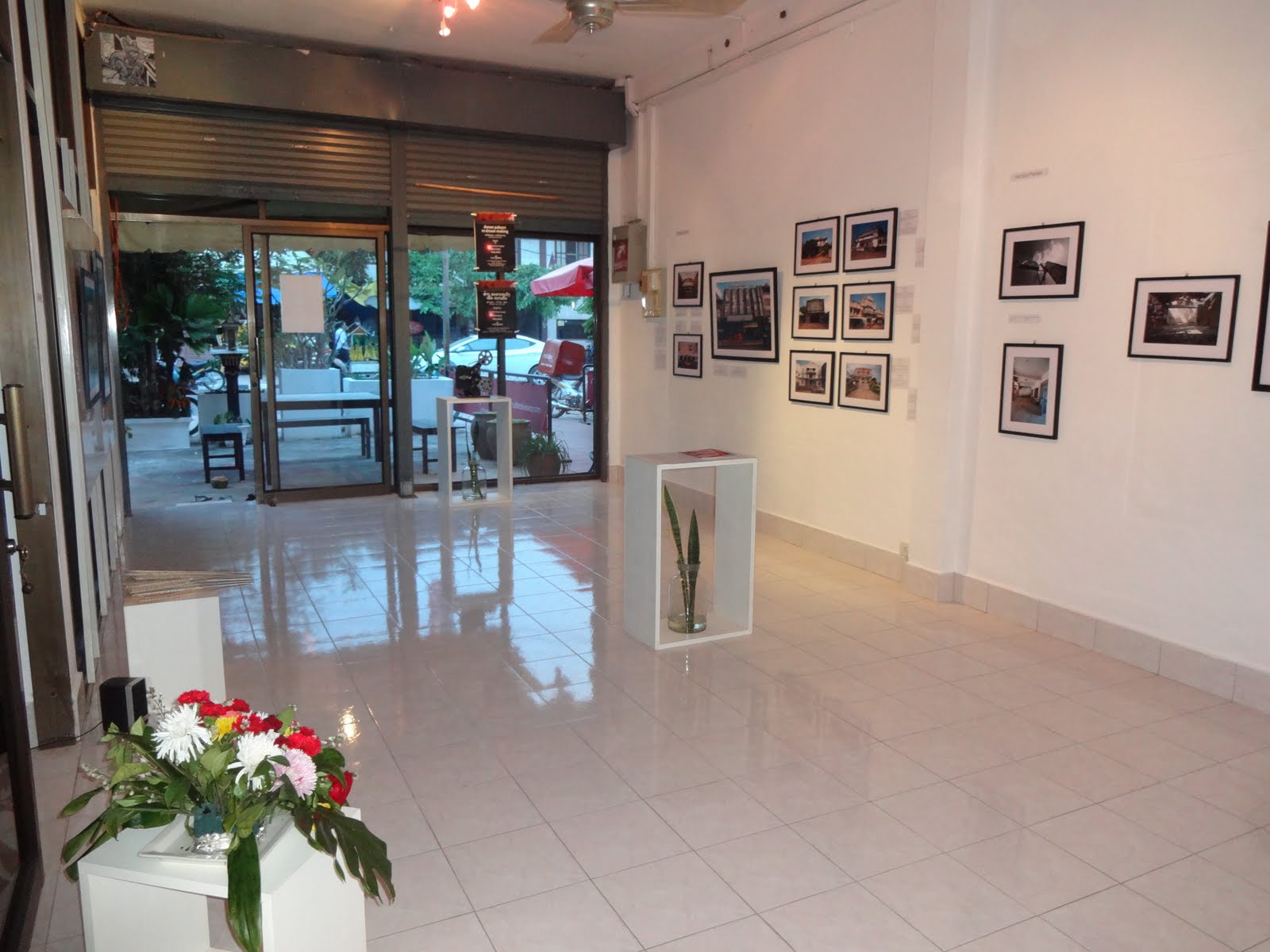
Below are a few shots from the SEA Movie Theater Project photo expo at the I:cat Gallery in Vientiane. The set was hung as part of the 3rd annual Vientianale International Film Festival, which ran from February 26th to March 2nd in the Laotian capital.

The Vientianale exhibition marks this project's second time being exhibited in Laos, it's sixth exhibition in conjunction with a film festival and it's eighth exhibition overall. With any luck there will be many more exhibitions to come. And if the gods of the cinema smile down upon me with enough zeal, maybe - just maybe - I will one day take to the road again. Boy, do I miss it. 


Friday, February 15, 2013

Vientainale Int'l Film Fest to Hold Exhibition

At the end of February, a full year will have passed since my last foray into movie theater documentation. This year long hiatus, following 4 years of more or less steady work, has indeed made the heart grow fonder. Hopefully something will give at some point down the road, and the chance to explore the towns and cities of Southeast Asia will arise. Hopefully, then, there will still be a few old theaters to chronicle. In the past year, the rate of attrition for stand-alone movie theaters in Southeast Asia has been extremely high. 

In the meantime, the photographic output of this project continues to show its wings. Just in time to celebrate the one year anniversary of my last documented theater, an new exhibition will be unveiled. 

The 3rd annual Vientianale International Film Festival, in Vientiane, Laos will feature as a side event a 10-image set of SEA Movie Theater Project photos. The images will remain on display at the I:Cat Gallery for two weeks after the end of the film fest, which will run from February 26th to March 2nd.

If you're in the neighborhood stop by and enjoy some free movies and photos.


Saturday, December 25, 2010

The Vieng Samay Revisited

On a recent trip to the Laotian capital, I made a stopover at the old Vieng Samay Theater, now the last theater structure in the city with visible evidence of its former life. It takes little more than a glance at the building's facade to understand its place in Vientiane's history. From the rusting marquee, to the faded, trilingual letters of the roof-top sign, there should be little doubt as to the building's past life. On the other hand, just next door stands the Sang Lao Hotel, which opened in 1953 as the Sang Lao Theater. The completeness of its functional conversion, however, has left it without a trace of its cinematic days. One would never know unless they knew.

All tallied, there have been eight different stand-alone theaters in Vientiane over the years. That's three more than I'd ever known about, but this figure was concluded by a lifelong city resident now in his late 50's, who'd taken a day to think it over. I take the man's word.

A group of young monks stroll past the remains of the Vieng Samay Theater, Vientiane's last theater structure with visible evidence of it cinematic days. It closed shortly after the Communist ascendancy in 1975.

A noodle vendor, beneath the green umbrella, rents the part of the open-air foyer.

Eating noodles in a lobby-no-more.

Forgotten ticket windows obscured by time and the accoutrements of a noodle soup business.

The owner/builder of the Vieng Samay Theater is apparently still alive, residing in a shop house just next to the theater. My requests to meet with him were turned down, however, on account of his fragile health after 90-plus years of life. Too bad, as that would have made for an insightful interview.

Like many privately owned enterprises in Vientiane and elsewhere in the country, soon after the royalist-to-communist regime change in 1975, the Vieng Samay Theater closed its doors, never to open again.

A salon table and sink in front of an old poster case, evidence that a beauty parlor has occupied a portion of Vieng Samay's lobby in recent years.

Art in an old poster case.

The Vieng Samay Theater dates to the late 1950's, a legacy of the first years of American economic and technical "assistance" to Laos during the Cold War era. As a palimpsest on Vientiane's urban landscape, it is a critical piece of the city's social past; one that certainly adds architectural and historical capital to an already varied urban tapestry. Unfortunately, such sentiments are likely not universally shared:
"Today, the Lao Communist Party (The Lao People's Revolutionary Party (LPRP))... is seeking new sources of legitimacy as the old sources - the struggle against foreign intervention, the construction of socialism - are rendered redundant. The LPRP has turned to the Lao past, presenting itself as the defender of ancient national and cultural traditions, in order to bolster its claims to power"*
Somehow I don't think the preservation of an American-era movie theater fits in with the LPRP's definition of "ancient national and cultural traditions" worthy of protection, even if the definition does comprise architectural-geographic heritage sites. In other words, I wouldn't count on the Vieng Samay being around much longer.

*(Askew, Long and Logan. (2010). Vientiane: Transformation of a Lao landscape (p. 5-6). New York: Routledge Press.)

Friday, February 12, 2010

Ode to the Odeon Rama - By Vince T

I don’t remember exactly when the Odeon Rama opened, but it was the last theater built in Vientiane in the late sixties or early seventies. I used to live nearby. It was the biggest and most beautiful theater in town, with comfy, red velvet seats.
Like all countries in Southeast Asia at that time, Indian and Chinese movies were popular among the local people. It was there that I discovered Bruce Lee, Bollywood and my favorite of all, the Monkey King movies, based on the classical Chinese novel “Journey to the West”.
They also played some Thai movies.
I remember one night when my parents brought me to see a French comedy starring Yves Montand and Louis de Funes. The atmosphere was strange to me that night. The theater was full of French people. It was the first time that I saw such a place filled with Europeans; so many white faces in one room. That night, the Odeon Rama was transformed into a movie theater near Odeon Place in Paris.
The Odeon Rama was one of my childhood playgrounds. My cousin and I used to hang around the theater grounds. One afternoon, we tried to sneak in through the back door. Just as we were about to enter, a woman's shrill voice yelled after us. We were caught. It was my auntie, standing angrily above us. We felt so ashamed. Now we laugh when we share this old souvenir together.
I left Vientiane in 1975 and moved to France. In 2006 I went back to Laos for the first time and stayed in a hotel near the Mekong River. One morning, I tried to find the path leading to the area where I used to live. Without asking for directions, I rediscovered the route towards my childhood turf. Suddenly, I came upon this dirty old building, the first floor was occupied by all kinds of shops. 'Yes, here I am,' I thought. 'It’s The Odeon Rama; so big and magnificent in my memories, but now so small, dirty and sad.' I asked a man: “is this the Odeon Rama Theater?" He replied yes. Then I switched on my camera and took this picture.

Now, like the Bua Savan Theater (Lotus Paradise in Lao), the Odeon Rama has been destroyed. I was lucky to see it as it took its last breath, the place where I discovered the joy of movies, “l‘amour du cinema”.
-------------------------------------------------------------------------------------------------
Great memoir and photo, Vince. I hope that your contribution will inspire others to send in their own.

Tuesday, October 20, 2009

Obituaries

I am actually a little bit saddened to make this announcement, but yesterday I received word from a reliable source that the Bua Savan Theater in Vientiane, Laos has been destroyed. A Vientiane fixture for film since at least as early as the 1960's, the Bua Savan operated throughout the latter years of the Lao Royalist era and most of Communist era, the transition point of which was 1975. I visited the old giant back in January of this year. Its image has served as the title banner for the Southeast Asia Movie Theater Project since I started it in March.


RIP
Bua Savan Theater
Vientiane, Laos
196? - 2009

____________________________________________________________________

In other grim news, last weekend I was down in Bangkok on yet another theater hunt and I noticed two recent casualties:

The street side sign and marquee for the Thai Rama on Somdet Prajao Thaksin Road, just off the Wong Wian Yai traffic circle has been taken down. I don't know whether the theater itself has been destroyed or not.

A sign no more

In the Sathon area of Bangkok, the sign and marquee for the Jan Theater and Snooker, once perched above the lot of a Caltex gas station on Jan Road has likewise been removed. Whether the theater itself remains or not is unknown.

A handsome sign, now likely in a scrap yard.

Saturday, April 25, 2009

The Vieng Samay Theater - Vientiane, Laos

Much like the Bua Savan (previous post), the Vieng Samay Theater was once a modern movie mecca in the heart of downtown Vientiane. Like its competitor around the corner, it too screened Thai films that were distributed by Grandma Yamjid, owner of the Thepbanterng Theater in Nong Khai, Thailand (see two posts prior). For the last 10-plus years the Vieng Samay has been nothing more than a facade.

The auditorium of the Vieng Samay has been demolished, leaving only a weedy lot in its wake. But for whatever reason the facade of the theater was spared. From a preservationist standpoint, this is a partial victory. If there is no chance of rehabilitating the theater to its original condition and the costs of maintaining the majority of the structure, even if it's used for other purposes, are not feasible, then at the very least preserving the facade - it's most recognizable feature - is a good thing. With any luck the facade's value will be realized some day and it will be professionally restored. Personally, I think it's one of the more unique theater facades I've seen in this part of the world, if not anywhere.

The sign atop the Vieng Samay Theater features Lao, Chinese and Roman lettering.

Noodle vendors now occupy the space which used to be the lobby.

The old marquee hangs tattered above the entrance.

The remains of the Vieng Samay Theater are literally around the corner from the Bua Savan and there is a hotel directly to the right of it which apparently also used to be a theater. That's at least 3 movie theaters in a relatively small area. Aside from those rudimentary bits of data, I wasn't able to learn much about the Vieng Samay Theater, but it was obviously once a luxurious place to watch a movie.

Thursday, April 23, 2009

Hong Nang Bua Savan - Vientiane, Laos

Before the May 17th, 1975 communist victory in Laos, Grandma Yamjid (find a brief bio of her in the prior post) distributed Thai films from Nong Khai to a few of the theaters across the Mekong River in Vientiane, Laos. The Bua Savan Theater was one of them.

Facade, palm tree and classic free-standing sign.

After the withdrawal of US-backed forces and the collapse of the royal regime, relations between Laos and Thailand melted down and trade slowed to a trickle. Among the items no longer entering Laos included Thai and American films. In their absence Laotian cinemas began to feature films from Russia, India, Vietnam and other communist countries.

Looking towards the front door, one section of which has been kicked in.

Now a shadow of its former self, the Bua Savan Theater still stands imposingly in the heart of Vientiane, a bi-level, single screen giant of yesteryear. Unfortunately the gaping hole in the roof over the auditorium, large enough to fit a mid-sized car through, suggests it won't around too much longer.

Looking towards the street from the trash strewn lobby.

Among the garbage littering the theater grounds, a discarded bra lies limpid, perhaps hinting that the abandoned Bua Savan has found new life.

An old poster case, still containing lobby cards from past films.

Presumably the last feature the Bua Savan showed, "Teenage Mutant Ninja Turtles 3". What a pathetic way to go out!

Lobby card for what I think is an Indian film, though it's Thai name translates to "Partial Heaven."

Another lobby card.

There was nobody around who could give me any details about the Bua Savan Theater when I visited it. I don't know when it was built, though I can guess it closed in the mid to late 1990's, a few years after Laos set out on a gradual return to private enterprise and the liberalization of foreign investment. A restructured economy, open to freer trade could have opened the door for an influx of cheap imported electronics, like TV's and VCR's, resulting in the shrinkage of the Lao movie theater industry and closure of the Bua Savan.

But fear not, there are newer, albeit less charming theaters in Laos these days. Vientiane has one in a shopping center and Pakse, the southern-most Lao city, has one above a bowling alley. There might even be more that I'm not aware of. But to be sure, none of the new ones can so much as hold a candle to the Bua Savan.