Showing posts with label Myanmar - Yangon Division. Show all posts

Thursday, July 12, 2018

The Padaythar Cinema - South Okkalapa, Yangon, Myanmar

Putting aside reports of ethnic cleansing going on in Rakhine State and the many unfulfilled political expectations, Myanmar as a whole has received glowing press coverage over the past several years. The super charged economy pegged to government reform, blossoming democracy and a budding arts and culture scene have made for many a fancy read about Southeast Asia's "final frontier."

That's all good. It's a fascinating country, after all, and I couldn't recommend a more worthwhile place to visit. But there is an egregious downside to the progress being made that isn't getting nearly as much attention as it deserves.

The unsustainable growth in the use of cars.  

In 2010 when I first visited the city, yeah, there were cars. There was even traffic jams. But now it's terrible. So terrible that the quality of public life has declined collectively so everyone can enjoy their own private ride in a car. Does that equation make sense? The total quality of life for all has plummeted, so that for the individual passenger in a car it can improve. It's a weird zero sum equation if you ask me.  

I know, I know. High traffic volume is an indicator of prosperity. A sign of progress. Please! Spare me the apologist sentiments for this pathetic century-plus lifestyle trend.

Yangon's charm is being choked out by the car. The municipal government chopped the sidewalks in half to increase the parking capacity. In the process they've kicked vendors who earned a living on those sidewalks off of them. All the quiet little side streets - the numerical streets - have become jammed with cars. It's really a pathetic scene. Anybody who tells you otherwise is clearly in love with their car-centric lifestyle.

Now that I've finished my rant, here's a little story about my trip to the South Okkalapa neighborhood to visit The Padaythar Cinema.  

I arrived there by taxi.

The Okkalapa's, both north and south, were essentially massive public housing projects. Their geneses began in the wake of the post-World War Two civil and ethnic conflicts that rocked newly independent Burma. Refugees fleeing the fighting poured into Yangon. The government responded by extending the city grid to the north and east, and filling it in with housing. A few movie theaters were built in the early 1960's to provide some much needed escape for the newly minted urbanites. Among them was The Padaythar.


The Padaythar Cinema stands in the middle of an overgrown field, gated off from the otherwise crowded South Okkalapa neighborhood. 


Cinema ruin in an overgrown field. 


Iron bars on the old ticket window


Nice foliage conveniently blocking my facade view. 


My cabby had a vague recollection of a neighborhood cinema tucked away somewhere in the middle of South Okkalapa. It's been at least 10 years since the Padaythar closed down; plenty of time for it to fade from memory. He stopped on few occasions to ask directions from various street hawkers and pedicab drivers until we found our way there. 

The midday sun was reddening my neck as I pushed open the shoulder-high chain link fence surrounding the cinema grounds. I walked across a dirt tract with what seemed to me like swagger, but I probably looked like a mad man. No more than 10 steps in and I was spotted by a rent-a-cop lazing in front of fan in the shade of the theater's veranda. He tried to wave me off, but I quickly turned the tables on him, beckoning him near as I strode purposefully towards the abandoned theater he guarded. As we neared each other, I slowly raised my SLR from its bag and, with the other hand, extended a finger towards yonder ruin. "I photograph movie theaters," I blurted in crummy Burmese. He shooed me off again, but I held tight, repeating my original phrase and adding "I like movie theaters very much," in earnest.

For my next gesture, I indicated with the flick of my hand that I only intended to shoot the exterior. With that he was convinced. Over the next ten or so minutes I made the photos that you see above. Interior shots were strictly forbidden.

When I had completed my work I thanked the guard, exited the theater grounds and haled a taxi back into town.

Sunday, April 8, 2018

The Shae Saung Cinema Revisted

There are two noteworthy sights on Sule Pagoda Road, Upper Block. The Nay Pyi Daw and Shae Saung cinemas.This duo of "Burmese Polychrome Theaters," both tidily maintained by Mingalar Cinemas, are the last vintage structures left on one of the most high profile blocks in the country. All other old buildings, including two more cinemas that once stood across the street, have been pulled down, bit by bit, over the past 20 years.

One might assume that the charming old stock of buildings that used to line this gateway thoroughfare were demolished to make way for new ones that reflect Myanmar's bright new demeanor since entering the world stage. Think again. Not a single one of the buildings which has replaced the old stock is worth a second look. Functional mediocrity, at best. Too bad collective confidence doesn't necessarily make cities look good.


The Shae Saung Cinema circa 2016

The Shae Saung Cinema, however, does look good. At least I think so. It and its sister theater - The Nay Pyi Daw - up the street are two beacons of the cityscape from a time when movie theaters were the proverbial living rooms of the city, and reflected that important social role in their architecture.

Many a visitor to Yangon have remarked about the two colorful movie theaters accentuating the block. Place makers in the truest sense.   


Street vendors in front of the Shae Saung provide cheap snacks to movie-goers while enliven the street. 


Crowds shuffle in at Stall level seating. A ticket taker stands by the door.

During past visits to The Shae Saung, as well as other Mingalar operated cinemas, I was never able to get past the front door. If I did it was only to slouch down in a seat for a movie. Facades were the most I could hope to document. Over the past two years, however, Mingalar and me have gotten familiar (the theater chain sponsored my most recent Myanmar theater survey). These days instead of swift dismissals by theater security, I get the red carpet treatment from theater managers and the privilege of full access to Mingalar's entire fleet of mid-century movie palaces. A golden ticket in the hyper-niche world of movie theater photography.

Here's a few shots of the auditorium I took between screenings. 


Balcony seating at the Shae Saung Cinema


The Shae Saung has over 600 seats, making it one of the largest movie theaters in Myanmar.


Comfort and luxury are trademarks of Mingalar Cinemas. The Shae Saung is no exception. 


Most theaters in Myanmar built prior to the Ne Win coup had English names, indicative of the country's past status as a colony of England. Soon after Ne Win took over, a policy was hatched that forced name changes from English to Burmese in a bid to restore a sense of dignity to the nation. Shae Saung translates to "Pioneer," but the cinema's original English name was "The Light House."

In this age of cut-rate architecture the name Light House seems more appropriate now than ever before. The Shae Saung Cinema is a beacon, a light house if you will, signaling a time when architectural design was not the domain of developers but of artists. Even if it's not your cup of tea aesthetically, it's hard to deny the artful design and its keystone role in the life of this once elegant block.


Friday, March 16, 2018

The Migalar Waziya AKA Waziya 2 Cinema - Hlaingthaya Township, Yangon

It would take nothing short of a military dictatorship feigning benevolence to erect a movie theater like the Waziya 2 Cinema up in Hlaingthaya Township on the outskirts of Yangon. I don't mean that cynically. Back in the early 1990's, no bottom-line minded private theater operator would have had the gumption to plop a massive movie hall in the middle of a rice field in the sticks. Stuff like that only happens when turning a profit is as easy as stealing the wealth of a nation.

Indeed, the kleptocrats behind the Than Shwe government went through a mysterious period of theater construction in the early to mid 1990's. At least 3 that I know of were built in Yangon, a few in Mandalay and others elsewhere, too. It may have simply been part of a wider infrastructure development initiative that the generals put in motion in the aftermath of the 1988 pro-democracy crackdown. Placate the citizenry with new roads, bridges, ports and why not a movie theater or two? What better way to make them forget how much they hate you?

Whatever logic lay behind this act of generosity, its legacy is a block of hulking concrete with a movie screen in it. Not an architectural beauty by any stretch, but looking at it, it's hard not to indulge in a little dystopian fantasy. You can just about feel big brother's cold, pan-optical gaze leering down at you from this cement cinema hall. Personal freedoms swapped for failed cradle-to-grave security and some propaganda films. Reality surrendered.

That's more the Soviet version than the Burmese Road to Socialism, but the look is the same. 


That was then, of course, and this is now. A brave new Burma is upon us, no longer fettered to the whims of dictators. Capitalism and the whims of the market have taken their place, and movie theaters are reverting to private ownership.

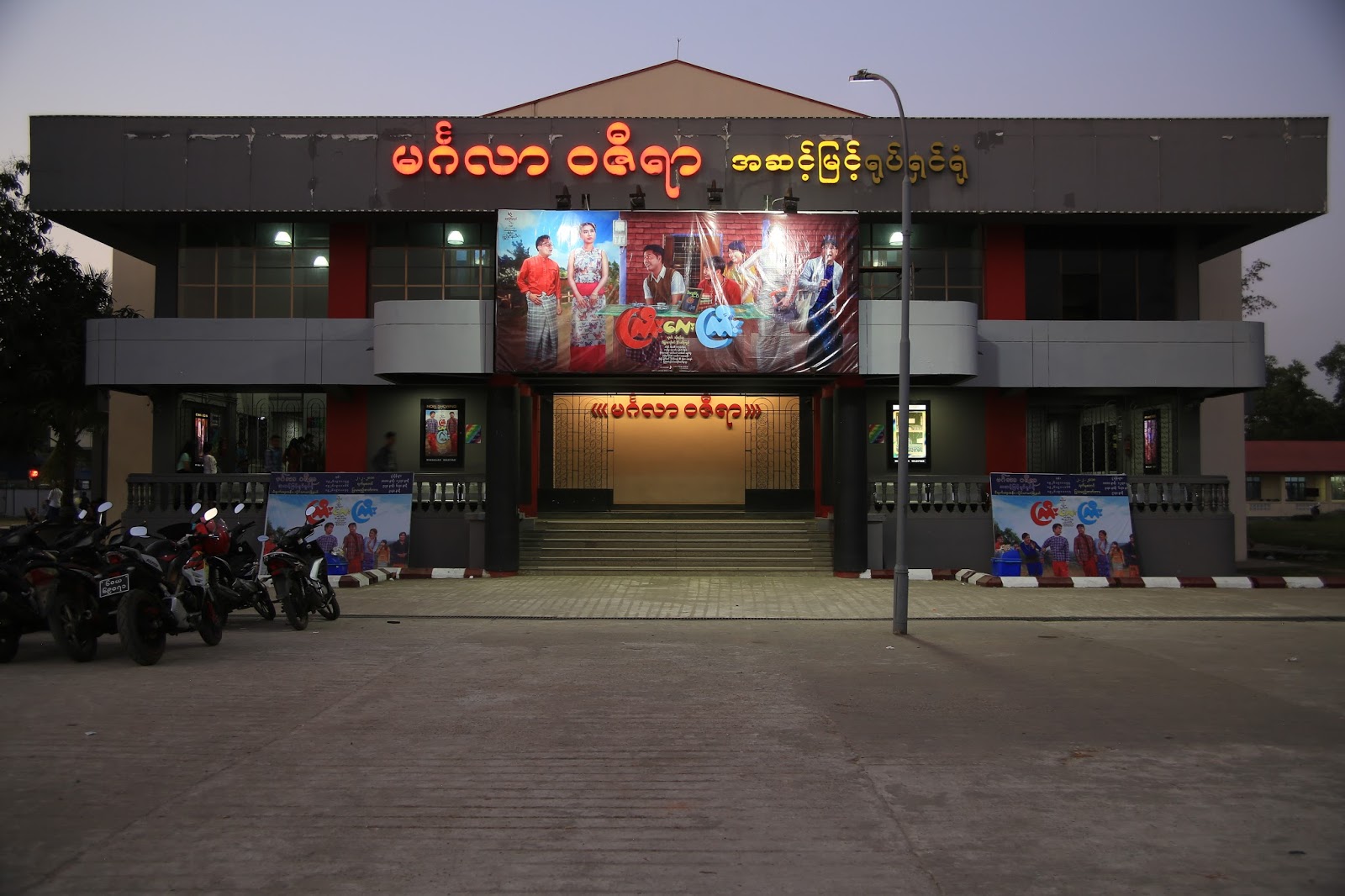
Enter Mingalar Cinemas. The Yangon-based theater chain - Myanmar's largest - acquired the Waziya 2 in 2015 following a two year spell of sitting dormant. The new owners sank some money into it, sprucing it up enough to mute the authoritarian look and adding some much needed pizzazz. They dropped the "2" from the title (Waziya "1" being a Beaux Arts beauty from the 1920's in downtown Yangon) and prefixed "Waziya" with the company name.

"At first we thought we would divide the single-screen auditorium into three smaller ones," a company rep told me, "but in the end we opted to keep it as one to accommodate larger crowds."

Since installing top-of-the-line Christie 4K Digital Projectors and Dolby Digital Sound, the new and improved Mingalar Waziya Cinema is doing better than ever.

"It's a good thing we kept the auditorium whole," mused the representative. "On weekends the theater is usually packed."


Crowds pour out of late afternoon Sunday screening at the Mingalar Waziya Cinema.

Packed house weekends are no exaggeration. I arrived on a late Sunday afternoon just in time for a screening to let out. A Burmese romantic comedy judging by the billboard. As I surveyed the grounds for prime angles to shoot, the theater's doors opened and a trickle of people sauntered out. Moments later the trickle turned into a deluge, as seemingly satisfied movie-goers poured out into the surrounding lot towards their bicycles, motorbikes and idling taxis parked outside the gates. It was a beautiful sight to behold. The good old fashioned collective pleasure of the cinema, sacrosanct in its concrete stand-alone guise, in full swing. If tickets for all 651 seats weren't sold then it was pretty close. 


A quartet of movie-goers go to the movies.


The side entrance of the Mingalar Waziya is where the box office and lobby are.


Box office 


Staff at the Mingalar Waziya cleans up the theater between shows.


Gentle illumination

Now, I don't know this for certain, but by the looks of it most of Hlaingthayar Township was probably agricultural in the 1990's when the Waziya 2, as it was originally called, was built. Most of the nearby structures look tellingly recent. Others are little more than slapdash huts by the side of the road and other developments on the fly. Between the two are tracts of fallow rice fields.

Nowadays, Hlaingthaya is thick with industry. Young factory workers and their families comprise the majority of residents, who in turn make up the bulk of the audience at the Mingalar Waziya. Prescient planning by the military gov. to plop a movie theater in a rice paddy that would soon be zoned industrial, densely populated and in need of leisure activities. And a wise move on the part of Mingalar Cinemas to buy it up, slap their brand on it and keep it intact.

-----------------------------------------------------------------------------------------------------------------------------------

For those of you who only follow The Southeast Asia Movie Theater Project blog and don't follow my Twitter, Instagram or Facebook feeds, you might not be aware that I'm in the midst of a crowdfunding campaign. The aim of the campaign is to raise funds for a feature length documentary about my work photographing old theaters in Thailand and Myanmar. Details of the campaign can be found by clicking here.


If you like the work I do, please consider chipping in. Even the smallest donation (200 Thai Baht, or $7 US in this case) helps.


Sunday, January 28, 2018

A Route to Myanmar's Movie Theaters

For the third consecutive year, ye olde Myanmar map will be put to good use.  From my starting line in Yangon, I plan on moving in a northwesterly direction up through Western Bago and then zig-zag  my way across Magwe, Mandalay and Sagaing Regions. Barring any holdups, the survey should end in either Myitkyina, Bhamo or Kalay before heading back down to Yangon by the 21st of February. I will try to squeeze in as many towns and their respective movie theaters as possible in a northerly race against a three-week time limit.


First stretch of the theater hunt. 


Dry Zone theater hunt route


Upper Myanmar theater hunt route

If all goes as planned I will get severely ill - possibly from food poisoning - lose some weight I can ill afford to lose, and maybe suffer a burn or two during this expedition. I will get diarrhea. Dehydration will get me once or twice. I will vomit. The civilian informants and local gendarmes who chased me out of Natmauk - General Aung San's birthplace - and Thandwingyi in 2011 will have hopefully found more useful things to do. I am bracing myself for the inevitable night at a flea bag hotel with mosquitoes, bed bugs and/or carpet beetles. I am bracing myself for the inevitable town with no hotel at all, or no licence to host foreigners. Strange skin irritations will come as no surprise. In the Dry Zone cities, I am prepared mentally to have a few unpleasant encounters with raging ethno-nationalists. I will try not to drink too much Myanmar Beer. I will forget to exercise. Loneliness followed by bouts of mild depression will creep up on me. I will photograph lots of old movie theaters. In the end, barring catastrophe, I will be smitten with Myanmar as usual.

You can follow me on Instagram and Facebook which I will be updating regularly while on this survey.


Thursday, March 17, 2016

Mutilated Cinema Row and other movie theater missives from Myanmar

Round 3 of the Myanmar Movie Theater Survey has come to a close. What was supposed to be a full 28 day-long expedition screeched to a premature halt, unfortunately, about a third of the way into it. A freak accident involving a scorching hot motorcycle tailpipe put a second degree burn on my heel, totally incapacitating me.

Likewise, the survey got off to an equally slow start, albeit not by my own doing. Demolitions and a cyclone simply left a dearth of material to document during the first leg of the trip.

But as bad as it all sounds, the in between was very productive, yielding almost as many new insights into Myanmar's movie theater archaeology as it did new photographs of old theaters. Above all else, it made me realize that 3 rounds of photography for Myanmar is not enough. Rounds 4 and 5 are thus in the pipeline.

The highlight of the survey was a panel talk on the subject of movie theater preservation held at Myanmar Deitta Gallery. The round table discussion took place in conjunction with an exhibition of Myanmar's Vanishing Movie Theaters, consisting of 15 images from my previous Myanmar surveys. About 60 people showed up for the talk, the main agenda of which was to draw attention to the plight of the Waziya Cinema - perhaps Myanmar's oldest existing cinema hall  

The low point of the trip - burned heel aside - was the fact that I waited 5 years to do it. About half of the theaters that I visited on this trip had closed down within that time frame. Others were demolished. Many vacant lots stood in place of what only a few years before was a mid-century movie theater. 

The most obvious loss to Myanmar's movie theater heritage since my last survey is "Cinema Row." Once the highest concentration of stand-alone movie theaters anywhere in Southeast Asia, the downtown Yangon strip went from having six theaters side by side to mere two. A before and after shot depicting the stretch of city is below.


Cinema Row c. 2010


Cinema Row c. 2016

But it's not all bad! As I start organizing my photos and notes I'll be sharing with you some surprisingly positive news from the Myanmar movie theater scene. Believe it or not, there are some interesting trends afoot. And unlike neighboring Thailand, where the crown jewel of movie theaters still faces the threat of demolition, the finest active theaters in Myanmar seem to be in very good hands.

More to come very soon.

Wednesday, February 17, 2016

Myanmar movie theaters in focus

It's been almost six years since my eyes were first opened to the charms of Myanmar's cinema halls. Six long years since that first foray into a country flush with stand-alones and where most towns still had the almost virginal grace of not being beholden to the automobile, or its requisite bedfellows in space-consuming infrastructure. I mention that because, besides the fact that I'm seriously prone to road rage, cars are the main cause of decline in stand-alone movie theaters. Not home entertainment systems, DVD's, VCR's and such things as most prevailing logic assumes. Yes, those gadgets play a strong role, but if cinema-going was killed off by home entertainment then why, at present, are there more movie screens in Bangkok, Chiang Mai and a half dozen other Thai cities than there ever has been in history? The answer is because 99.9% of those screens are in shopping malls, the primary access point for which is the parking garage, via car, and Thailand is a car dependent country. Oil addicted, one might say. Going to the movies is still a beloved pass-time, but now a huge percent of those able to afford a movie ticket in Thailand live in car dependent suburbs, or are simply just accustomed to driving everywhere. The thousand seat stand-alone movie theater that once stood in the heart of town didn't supply secured parking. The multiplex theater in the shopping mall at the edge of town does. But I digress.

My last trip to Myanmar for a theater survey was back in January, 2011. Five years ago. That netted me a huge amount of photographic content from Shan State, Magwe, Bago and Thanintharyi divisions. Ever since then I've been yearning to get back there to pick up where I left off. By my estimates, there are are still a solid 30 or 40 old theaters yet to be documented in Myanmar, a good portion of which may still be in operation. But that number is dropping fast.

After mulling it over, I decided that there's no better time than the present. Tomorrow, February 18th, I'm flying over to Yangon to start a third Myanmar movie theater survey. This trip will hopefully lead me trough Irrawaddy Division, then back up to Shan State, into Kachin State, back down through Sagaign, Mandalay, Magwe and Bago Divisions, and ultimately into Mon and Karen states. I'm not sure that all of that is possible given only 28 days, but I will do my best.

In addition to the survey there will be a photo exhibition of some of my past work in Myanmar opening on February 20th at Myanmar Deitta Gallery on 44th Street just off Merchant Road in downtown Yangon. All 15 images on display will be for sale to help offset the cost of this expedition.

The highlight of this exhibition will be a panel discussion on the important social and cultural role of the cinema hall. Aside from myself, panelists will include US Ambassador to Myanmar Derek Mitchell; Yangon Heritage Trust director Daw Moe Moe Lwin; Director of Urban Planning for the Yangon City Development Committee Dr. Toe Aung and Myanmar Motion Picture Organization Patron U Aung Lwin. Our talk will hopefully build awareness to the plight of the Waziya Cinema a classic downtown movie palace in Yangon which recently closed down.

Below are a collection of photos of Myanmar cinema halls that have either closed or been demolished since I was last there.


Thida Cinema - Yangon. Closed 2013


Kemarat Cinema, Keng Tung, Shan State. Demolished 2012


Win Cinema, Toungoo, Bago Division. Demolished 2012


Shwe Mann Cinema, Yangon. Demolished 2012


Myoma and Shwe Gon cinemas, Yangon. Demolished 2012


King Cinema, Yangon. Demolished 2012


Hsoo Htoo Pan Cinema, Yangon. Demolished 2012

Sunday, September 8, 2013

Classic Yangon cinema to get preservation treatment

The preservation of old structures is like a balancing act. While it would be nice to salvage every quality old building and restore or repurpose them to new found grandeur, the odds of doing so are slim. Battles for preservation are more successful when the are selectively fought. As a rule of thumb, old and under-performing structures must make way for the new and profitable, sometimes at the expense of good architecture. In the world of urban real-estate, where land is typically scarce, this rule is all the more immutable, especially when it comes to buildings that are expensive to maintain.

Fortunately there are exceptions to this rule. Savy municipalities take strides to preserve their structural antiquities when possible, conscious of the fact that with the passage of time older structures can gain an irreplaceable allure.

In Yangon, Burma, architectural preservation has become a popular topic. With international capital rushing in to the frontier market, a country saturated with natural resources and inexpensive labor, Yangon's vast inventory of aging architecture has come under duress, and both locals and visitors have noticed.

Downtown Yangon has very little vacant land to accommodate the fledgling free-market economy. Property owners hoping to cash out from the current economic boom are eager to sell for the right price. On Bogyoke Aung San Rd., a stretch of city informally known as Cinema Row due to the more than half dozen movie halls that have crowded the area for decades, redevelopment is everywhere. In the last year at least 3 of the 6 remaining theaters on Cinema Row have been leveled, giving way to high-rise hotels and office towers.

But in keeping with the balancing act analogy, it sounds as if at least one theater will survive the demolition unscathed, if not enhanced. And it couldn't be a better one.


The Waziya Cinema on Bogyoke Aung San Rd.


Details of the veranda


Entrance to lower level seating


An usher awaits patrons along the corridor of upper level seating

According to a Facebook post by Thant Myint U, the leading voice of Yangon's architectural preservation movement, there is talk of revitalizing the Waziya Cinema - the oldest and most architecturally intact of all the Cinema Row movie theaters. Dating to the 1920's, the Beaux-Arts Waziya - originally known as the Excelsior -  is one of the oldest active theaters in all of Burma, if not broader Southeast Asia.

Interest in its preservation seems to have gained momentum from having hosted the 3rd annual Watthan Film Festival, giving the old picture house exposure on a broader platform.


Night shot of the Waziya Cinema

Should the Waziya get restored this will be a huge victory for Yangon's architectural preservation movement. And for stand-alone movie theater enthusiasts, this will be enormous.

But vigilance must remain high, as there are three more elegant theaters in the vicinity in the Nay Pyi Daw, the Shae Saung and the Thamada that might also face the wreckers claw.

Hopefully this news will be noted over in neighboring Thailand, where the fate of Bangkok's exquisite Scala Theatre is still in limbo.


Thursday, September 29, 2011

The Yadana Pon Cinema - Yangon, Myanmar

From deep in the vaults, a near-forgotten specimen of leisure-time yore is dragged to the surface. The Yadana Pon Cinema stands dormant near busy Dagon Center, its late-Burmese Art-Deco exoskeleton faded but in tact.

Fatigue had overtaken me by the time I found it, having just come from a fruitful but physically taxing shoot of the Shwe Man Cinema around the corner. A dead theater following a stint in the Shwe Man's vitality failed to get the juices flowing. My typical enthusiasm when facing a stand-alone was absent, I admit, so in the name of energy conservation, I snapped off a few lazy shots from across the street.

Plain white tile adorns the Yadana Pon's facade.

Even in death, the Yadana Pon is the most attractive building on the block.

The Yadana Pon is in the heart of Sanchaung Township - one of the most congested parts of Yangon outside the colonial grid. A few hundred meters away, the enormous Dagon Center shopping mall attracts the city's middle class youth in droves. Despite its relative prosperity, Sanchaung, like most areas of Yangon above the rustically charming grid, is littered with structures built with seemingly nothing in mind but cost effectiveness. The exception is the Yadana Pon Cinema - dormant, darkened and awaited a fate as of yet unknown.

Tuesday, February 15, 2011

The Sandar Myaint Cinema - Yangon, Myanmar

In a country where the majority of old movie houses were built with pride and high craftsmanship, the Sandar Myaint Cinema calls to mind a minimum security prison. All it needs is a chain link fence with barbed wire on the top and it fits the bill to a tee. No awards for architectural design are going out to this one, that's for sure.

It's worth mentioning, however, that the theater ceased showing movies a number of years ago. Now it serves as a warehouse for non-perishables. Its stark appearance probably has something to do with that. Moreover, it's possible that in its hey day the Sandar Myaint boasted of cosmetic ornamentation that has since been removed for safety reasons, painted over, or simply left to fade in the sun. That is to say, don't let its beastly present overshadow a potentially illustrious past. Sure enough, there is one tell-tale sign indicating that there's more than meets the eye.

Baby blue never looked so menacing as it does on the Sandar Myaint Cinema

Green on blue

One of the Sandar Myaint's entrances is equipped with this tell-tale gate, featuring a pattern of A's and 1's repeated over and over. If my conjecture is correct, this represents the A-1 Film Company, one of Myanmar's most prolific movie studios of yesteryear. This family-owned and operated company produced many of Burma's most beloved films of decades passed, helping to grow the Burmese film industry into one of the most advanced in Southeast Asia. But like almost everything which was once first-rate in the country, years of hardship under an oppressive ruling regime has forced the A-1 studio out of business and led to one of the most negligible national film industries anywhere.

For an extreme - if not telling - example of how the present-day film industry in Myanmar has fallen from grace, watch the recently released documentary "This Prison Where I Live." It tells the story of Zarganar, Myanmar's top comedian, director and movie star, who is now languishing in jail under a 59-year sentence. This is a poignant documentary, with an important agenda, yet brimming with moments of hilarity so representative of the man it's about. Highly recommended!

Ticket window stills

Hand made switch board in the ticket window.

Flaking paint on the balcony staircase.

As if the Sandar Myaint lives on as a cinema, a vendor selling pop-corn does business beneath the awning. Ice cream is available as well.

Myanmar style signage.

Whether or not the Sandar Myaint was once owned by the A-1 Film Co. is not known, though the A's and 1's welded into the front gate certainly give that impression. This is a bit of data I hope to have answered in the future, along with much more about Myanmar's once prestigious movie studios. Currently there is a dearth of available literature on the subject.

To see the Sandar Myaint with your own eyes, head out to the intersection of Pyay Road and Than Street, in Yangon's Hlaing neighborhood.

Sandar Myaint translates to "Abode of the Moon."

There's no available data as to when it was constructed.