Saturday, March 16, 2013

As viewed in Vientiane

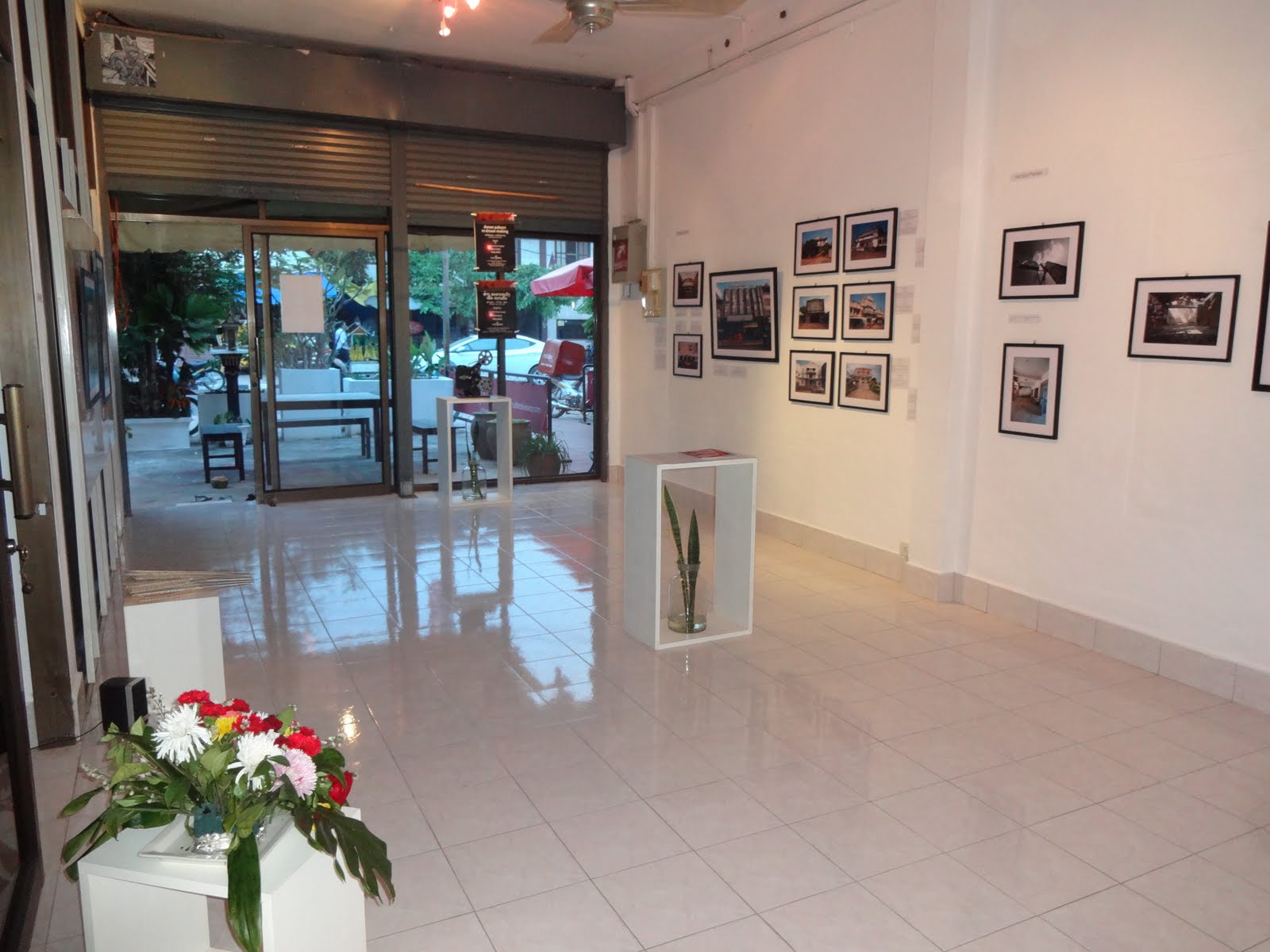
Below are a few shots from the SEA Movie Theater Project photo expo at the I:cat Gallery in Vientiane. The set was hung as part of the 3rd annual Vientianale International Film Festival, which ran from February 26th to March 2nd in the Laotian capital.

The Vientianale exhibition marks this project's second time being exhibited in Laos, it's sixth exhibition in conjunction with a film festival and it's eighth exhibition overall. With any luck there will be many more exhibitions to come. And if the gods of the cinema smile down upon me with enough zeal, maybe - just maybe - I will one day take to the road again. Boy, do I miss it. 


Thursday, March 7, 2013

Scala upgrades to digital projection


By Kong Ritdee
Bangkok Post, March 7, 2013
For 42 years Scala cinema has projected films as film was supposed to be projected: with 35mm print, rolled into a plate as light beams through the strips and atomises the moving pictures that hit the screen. Now the theatre has evolved, along with the whole world.

As the last functional stand-alone cinema in Bangkok, Scala, Siam Square's icon, is also among the last movie houses in town to have upgraded its projection system to digital.
Professional estimates have it that by the end of 2015, the global transformation to digital projection will be complete. More than 80% of cinema screens in Europe are now digitally equipped, for instance, and there are more than 12,000 digital screens in China as of last year. About half of the movies we see in Bangkok today are being shown digitally _ through Digital Cinema Package, a sort of hard drive that plays high-definition video images.
Scala, one of the two cinemas of Apex Group in Siam Square, showed its first digitally projected film last Thursday, the thriller Stoker starring Nicole Kidman. At the nearby Lido, also an Apex outfit, two of the three screens have already been upgraded to digital; the first film to be shown in the new format is Jack The Giant Slayer.
The upgrade to digital of Scala and Lido means more than just technical advancement. Last year, news about the imminent demolition of Lido, and possibly Scala, prompted a quick and passionate outcry of people who regarded the two cinemas as historical landmarks and even as the last stronghold against the fervid urban expansion. Even though Chulalongkorn University, which owns the space, alleviated fears by assuring that there was no immediate plan to demolish the two cinemas, the situation seems to be hanging in uncertainty.
By investing in the expensive digital projectors, however, Apex seems to be indirectly giving hope to its fans. If Scala and Lido were about to be demolished, as the rumour mill keeps stating, the operator wouldn't have spent money upgrading the system. Or at least that's the reading from observers. An executive of Apex doesn't confirm this though. In a phone conversation, he only said that the cinemas need to adapt to the changing times, since digital is becoming the norm. He didn't elaborate on the future of Scala and Lido.
Most cineplexes charge higher prices for digital screenings, but Scala and Lido are charging the same 100 baht _ still the cheapest. This is why people love them, analogue or digital.

Thursday, February 28, 2013

SEAMTP exhibit included in Chop Shots video recap

Here's a video recap from the Chop Shots Documentary Film Festival S.E. Asia held last December in Jakarta, Indonesia. At 1 minute, 52 seconds there are some good shots of the SEA Movie Theater Project exhibit that accompanied the festival.

Thursday, February 21, 2013

The Peth Kasem Theater - Nakon Pathom, Thailand (Guest Photos)

The 1997 Asian Financial Crisis was bad for Thailand's independent movie theaters. From the moment of impact, followed by months of downward spiral, scores of already-struggling family movie theaters closed their doors as crowds and access to credit grew scarce. The crisis came to a head because of unregulated speculation in the Thai currency market. When that speculation bubble burst, the financial system collapsed, leaving countless theater operators, with their costly overhead and dwindling attendance, out in the cold. (Of course, the impact went well beyond just theater operators, but for our interests here at the SEA Movie Theater Project, we'll stop at their lament.)

Featured below is the Peth Kasem Theater, a casualty of the '97 crisis located in the Bangkok satellite city of Nakorn Pathom. Like most small Thai cities, many of Nakorn Pathom's locally owned and operated movie theaters closed after the '97 meltdown. Today the structure lives on as a dingy parking garage in a narrow alley, its former luster a thing of the past.


The Peth Kasem Theater once had a seating capacity of 1,200.


Veranda area


What was once the concessions area.


Side doors


Poster of former starlet Jarunee found in upper level.


"Projection room"

It's good fortune that there are a few followers out there who take the time to send in their own movie theater photos. The Peth Kasem is one such submission. These photos come courtesy of a dedicated friend of the Southeast Asia Movie Theater Project, Regis Madec, who's web-site Thai Worldview lists, among other things, numerous Thai film synopses and listings. It's a great resource for those with a yen for Thai cinema.


Friday, February 15, 2013

Vientainale Int'l Film Fest to Hold Exhibition

At the end of February, a full year will have passed since my last foray into movie theater documentation. This year long hiatus, following 4 years of more or less steady work, has indeed made the heart grow fonder. Hopefully something will give at some point down the road, and the chance to explore the towns and cities of Southeast Asia will arise. Hopefully, then, there will still be a few old theaters to chronicle. In the past year, the rate of attrition for stand-alone movie theaters in Southeast Asia has been extremely high. 

In the meantime, the photographic output of this project continues to show its wings. Just in time to celebrate the one year anniversary of my last documented theater, an new exhibition will be unveiled. 

The 3rd annual Vientianale International Film Festival, in Vientiane, Laos will feature as a side event a 10-image set of SEA Movie Theater Project photos. The images will remain on display at the I:Cat Gallery for two weeks after the end of the film fest, which will run from February 26th to March 2nd.

If you're in the neighborhood stop by and enjoy some free movies and photos.


Tuesday, January 15, 2013

As seen in Semarang

Another exhibition is upon us, folks. Following the Chop Shots Southeast Asian Documentary Film Fest in Jarkarta, Indonesia this past December, the Southeast Asia Movie Theater Project photo series has changed locales. Its latest home is at the Dutch-Indonesia Cultural and Language Center, in the city of Semarang.

Not many more details to report than that. So if you should find yourself in Semarang, or have it as a destination on your Indonesian itinerary, drop by the Center and have look at some pretty photos of Southeast Asia's dwindling stand-alone movie theaters. A guaranteed treat for your eyes.


Thursday, January 3, 2013

Thailand's scintillating dimensional signage


Organizing Southeast Asia's movie theaters into distinct architectural categories has become a key component of this project. The numerous categories to define lead to an even richer number of subcategories to delve into. A more difficult task is trying to get the general public, to say nothing of those in the architectural field, to accept these categories as legit.

Some of the more obvious categories can be broken down by era, region or country. At its most specific, a single architect might be responsible for a certain look. But no matter which view one chooses to take, each characteristic is fixed in time and geography, and belies a greater cultural influence.

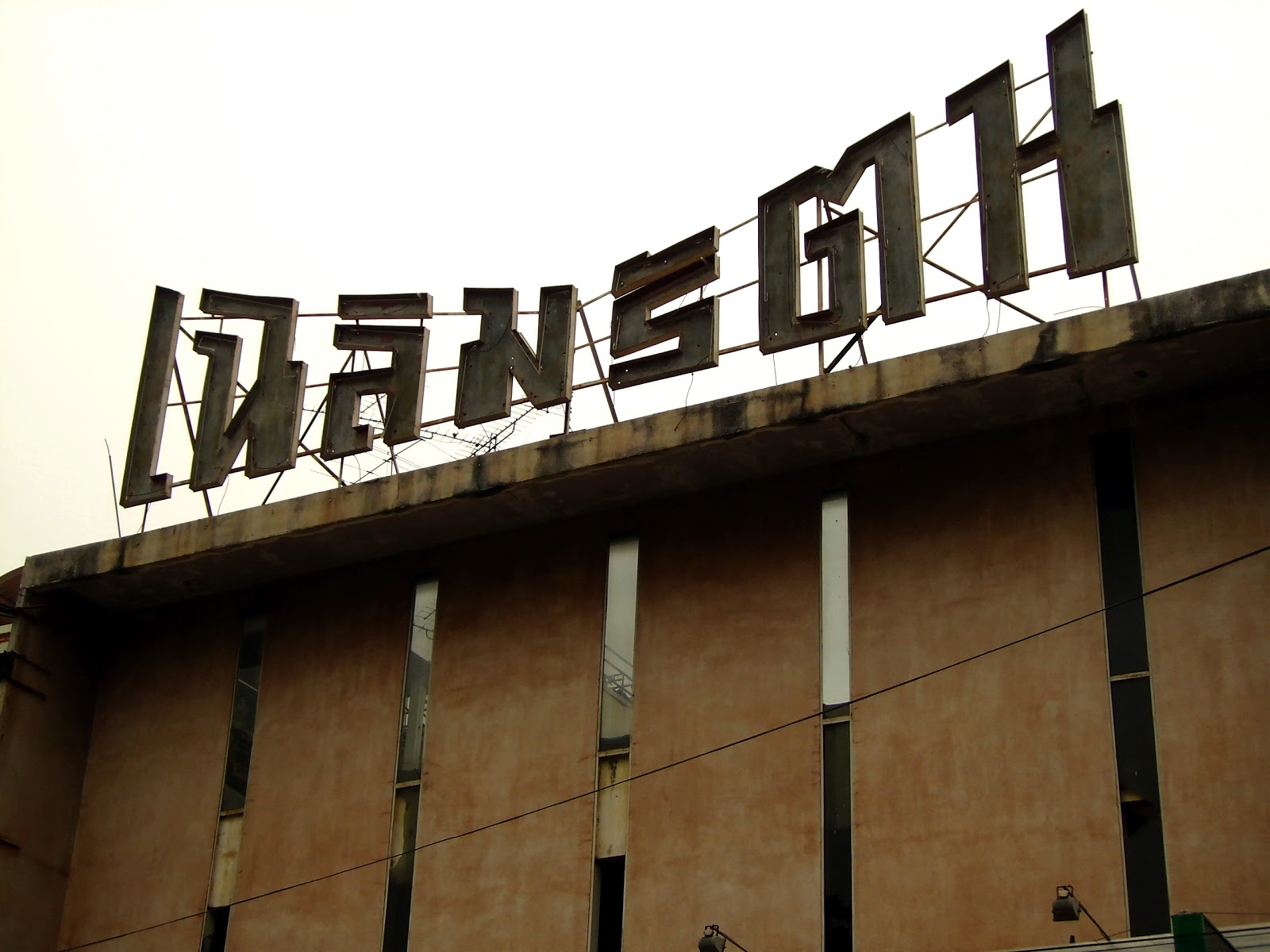
Although by no means exclusive to Thailand, rooftop dimensional signage was almost universal on Thai stand-alone movie theaters built between the 1930's and 1980's. No conversation about Thai theater architecture from this era would be complete without its mention. Decorative fonts were combined with neon-lit outlining to create what was often the most attractive signage around. This eye-catching detail, usually mounted on the theater's roof, is completely absent from Burmese cinemas. In neighboring Laos, however, it did occasionally occur.

So in homage to this nearly-lost art, one of the boldest signatures in movie theater architecture out there, here's a series of dimensional signs from Thailand.

Enjoy


The Phaholtothin Rama (streetside signage) - Bangkok


The Phaholyothin Rama - Bangkok


The Somdet Theater - Somdet, Kalasin


The Sri Nakorn Phapayon - Hang Chat, Lampang


The Malai Rama - Lopburi


The Nakorn Suwan Rama - Nakorn Suwan


The Pua Rama - Pua, Nan


The Taphan Hin Rama - Taphan Hin, Pichit


The Chalerm Rath - Udonthani


The Ubol Phapayon - Ubol Ratchathani


The Sri Saket Rama - Sri Saket


The Amarin Rama - Suwan Khalok, Sukhothai