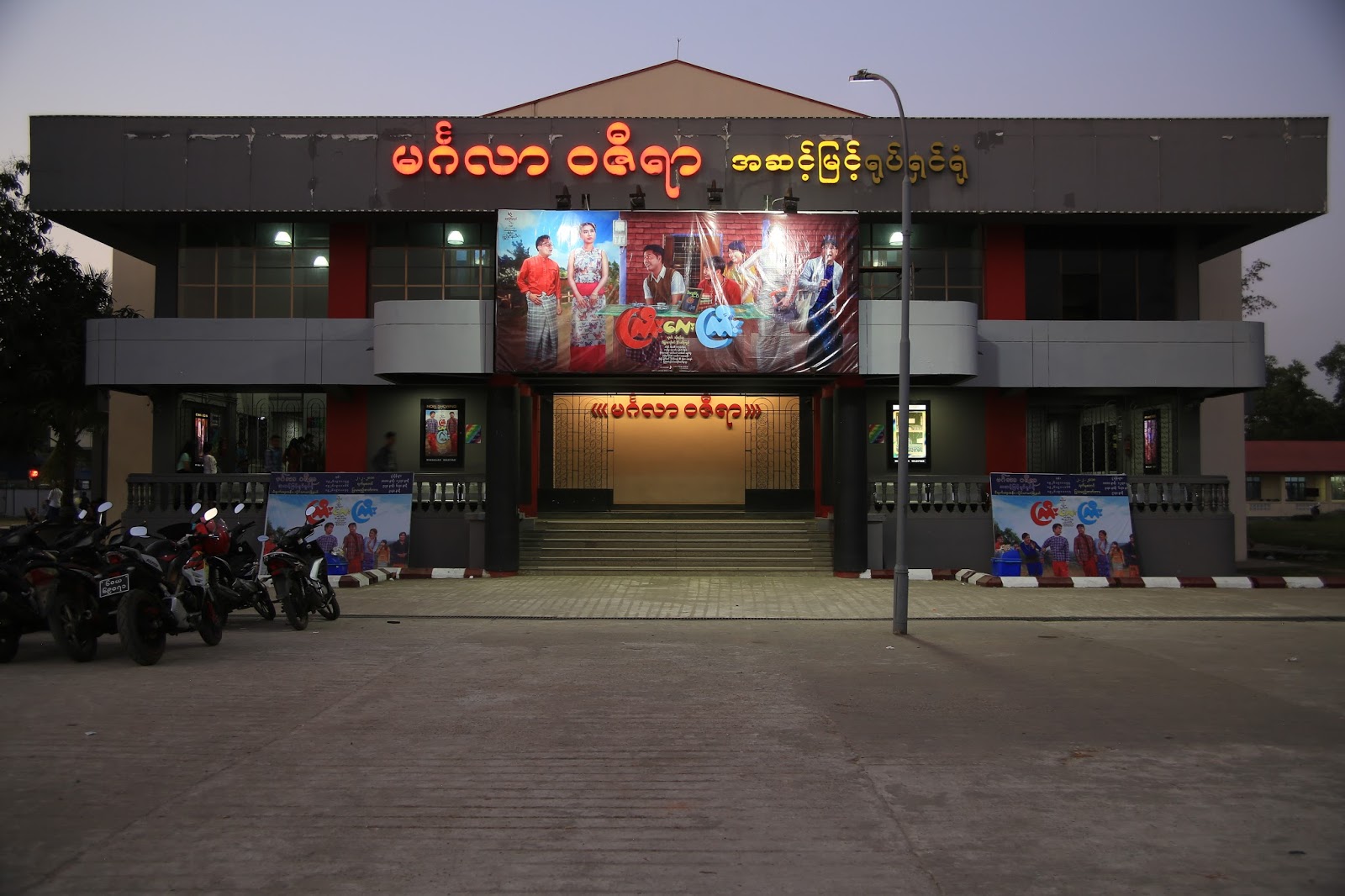
From Mogok in the mountains I journeyed back down to the lowlands and the dusty streets of Mandalay. A solid six hour drive by car, repressing vomit all the way.
If I haven't professed my disappointment at what has become of Mandalay, the storied former capitol of the Kingdom of Burma, let me do so - in brief - now.
Mandalay has been the victim of two waves of destruction in recent times. In the 1980's large portions of the city were devastated by fire, sending countless pieces of vintage architecture up in smoke. Many residents were displaced on account of it. The new structures that have replaced the old are hideous, with almost zero exceptions.
More recently Mandalay has turned into a major transit center for goods coming and going from all directions. While beneficial for the economy, Mandalay authorities seem to be unable (if not uninterested) to check the type of development which the boom has brought. That said, the going development theme across the city is to pull down architectural antiquities in favor of cheap new construction. This shortsightedness on the part of municipal authorities is pretty widespread around the world, but never have I seen it more wholesale than in Mandalay. At least not in the Southeast Asian context. As a result, Mandalay might be the least interesting city in the region from an architecture and design perspective.
If it weren't for the happy fact that Mingalar Cinemas, Myanmar's biggest movie theater operator, painstakingly cares for a few grand old picture palaces, I might completely write the place off.
First on my Mandalay cinema odyssey is the Win Lite.
Elevated view of the Win Lite Cinema
The Win Lite is the only remaining mid-20th century movie hall in Mandalay. It has managed to avoid both fire and rampant, shoddy development. When I last conducted research in the city in 2010 there was another 1950's era theater - the Ma Soe Yein Cinema - but that was recently demolished, leaving the Win Lite, which dates to 1958, as the oldest surviving movie theater in town.
From my narrow Yankee perspective the Win Lite Cinema could easily pass for a New Deal-commissioned government building in just about any American city. Its heavy, streamlined modernism exudes authority, much like the similarly fashioned courthouses and post-offices of 1930's America. Strength, reliability, deliberateness. "We will give you your dose of entertainment along with food and gas rations."
A simple but elegant waiting area
The lobby area in this post-independence era movie hall is narrow compared to the spacious auditorium. It's as if - in keeping with its regimented aesthetic - loitering around the lobby area was intentionally discouraged. An in and out affair. Get you entertainment rations and be gone.
Lower level seating
Mingalar Cinema staff was kind enough to allow me photograph the interior while a film was screening.The Win Lite contains 641 seats in total
Exiting crowds
My afternoon at the Win Lite left me feeling slightly optimistic. A Valentine's Day crowd of mostly young couples packed the house to watch what looked like a well produced Myanmar romance. Capacity crowds like this are the exception rather than the norm, but theater management assured me that a steady stream of regulars keeps the Win Lite well in the black. Encouraging news in this era of movie streaming and "instatainment."
There are two noteworthy sights on Sule Pagoda Road, Upper Block. The Nay Pyi Daw and Shae Saung cinemas.This duo of "Burmese Polychrome Theaters," both tidily maintained by Mingalar Cinemas, are the last vintage structures left on one of the most high profile blocks in the country. All other old buildings, including two more cinemas that once stood across the street, have been pulled down, bit by bit, over the past 20 years.
One might assume that the charming old stock of buildings that used to line this gateway thoroughfare were demolished to make way for new ones that reflect Myanmar's bright new demeanor since entering the world stage. Think again. Not a single one of the buildings which has replaced the old stock is worth a second look. Functional mediocrity, at best. Too bad collective confidence doesn't necessarily make cities look good.
The Shae Saung Cinema circa 2016
The Shae Saung Cinema, however, does look good. At least I think so. It and its sister theater - The Nay Pyi Daw - up the street are two beacons of the cityscape from a time when movie theaters were the proverbial living rooms of the city, and reflected that important social role in their architecture.
Many a visitor to Yangon have remarked about the two colorful movie theaters accentuating the block. Place makers in the truest sense.
Street vendors in front of the Shae Saung provide cheap snacks to movie-goers while enliven the street.
Crowds shuffle in at Stall level seating. A ticket taker stands by the door.
During past visits to The Shae Saung, as well as other Mingalar operated cinemas, I was never able to get past the front door. If I did it was only to slouch down in a seat for a movie. Facades were the most I could hope to document. Over the past two years, however, Mingalar and me have gotten familiar (the theater chain sponsored my most recent Myanmar theater survey). These days instead of swift dismissals by theater security, I get the red carpet treatment from theater managers and the privilege of full access to Mingalar's entire fleet of mid-century movie palaces. A golden ticket in the hyper-niche world of movie theater photography.
Here's a few shots of the auditorium I took between screenings.
Balcony seating at the Shae Saung Cinema
The Shae Saung has over 600 seats, making it one of the largest movie theaters in Myanmar.
Comfort and luxury are trademarks of Mingalar Cinemas. The Shae Saung is no exception.
Most theaters in Myanmar built prior to the Ne Win coup had English names, indicative of the country's past status as a colony of England. Soon after Ne Win took over, a policy was hatched that forced name changes from English to Burmese in a bid to restore a sense of dignity to the nation. Shae Saung translates to "Pioneer," but the cinema's original English name was "The Light House."
In this age of cut-rate architecture the name Light House seems more appropriate now than ever before. The Shae Saung Cinema is a beacon, a light house if you will, signaling a time when architectural design was not the domain of developers but of artists. Even if it's not your cup of tea aesthetically, it's hard to deny the artful design and its keystone role in the life of this once elegant block.
It would take nothing short of a military dictatorship feigning benevolence to erect a movie theater like the Waziya 2 Cinema up in Hlaingthaya Township on the outskirts of Yangon. I don't mean that cynically. Back in the early 1990's, no bottom-line minded private theater operator would have had the gumption to plop a massive movie hall in the middle of a rice field in the sticks. Stuff like that only happens when turning a profit is as easy as stealing the wealth of a nation.
Indeed, the kleptocrats behind the Than Shwe government went through a mysterious period of theater construction in the early to mid 1990's. At least 3 that I know of were built in Yangon, a few in Mandalay and others elsewhere, too. It may have simply been part of a wider infrastructure development initiative that the generals put in motion in the aftermath of the 1988 pro-democracy crackdown. Placate the citizenry with new roads, bridges, ports and why not a movie theater or two? What better way to make them forget how much they hate you?
Whatever logic lay behind this act of generosity, its legacy is a block of hulking concrete with a movie screen in it. Not an architectural beauty by any stretch, but looking at it, it's hard not to indulge in a little dystopian fantasy. You can just about feel big brother's cold, pan-optical gaze leering down at you from this cement cinema hall. Personal freedoms swapped for failed cradle-to-grave security and some propaganda films. Reality surrendered.
That's more the Soviet version than the Burmese Road to Socialism, but the look is the same.
That was then, of course, and this is now. A brave new Burma is upon us, no longer fettered to the whims of dictators. Capitalism and the whims of the market have taken their place, and movie theaters are reverting to private ownership.
Enter Mingalar Cinemas. The Yangon-based theater chain - Myanmar's largest - acquired the Waziya 2 in 2015 following a two year spell of sitting dormant. The new owners sank some money into it, sprucing it up enough to mute the authoritarian look and adding some much needed pizzazz. They dropped the "2" from the title (Waziya "1" being a Beaux Arts beauty from the 1920's in downtown Yangon) and prefixed "Waziya" with the company name.
"At first we thought we would divide the single-screen auditorium into three smaller ones," a company rep told me, "but in the end we opted to keep it as one to accommodate larger crowds."
Since installing top-of-the-line Christie 4K Digital Projectors and Dolby Digital Sound, the new and improved Mingalar Waziya Cinema is doing better than ever.
"It's a good thing we kept the auditorium whole," mused the representative. "On weekends the theater is usually packed."
Crowds pour out of late afternoon Sunday screening at the Mingalar Waziya Cinema.
Packed house weekends are no exaggeration. I arrived on a late Sunday afternoon just in time for a screening to let out. A Burmese romantic comedy judging by the billboard. As I surveyed the grounds for prime angles to shoot, the theater's doors opened and a trickle of people sauntered out. Moments later the trickle turned into a deluge, as seemingly satisfied movie-goers poured out into the surrounding lot towards their bicycles, motorbikes and idling taxis parked outside the gates. It was a beautiful sight to behold. The good old fashioned collective pleasure of the cinema, sacrosanct in its concrete stand-alone guise, in full swing. If tickets for all 651 seats weren't sold then it was pretty close.
A quartet of movie-goers go to the movies.
The side entrance of the Mingalar Waziya is where the box office and lobby are.
Box office
Staff at the Mingalar Waziya cleans up the theater between shows.
Gentle illumination
Now, I don't know this for certain, but by the looks of it most of Hlaingthayar Township was probably agricultural in the 1990's when the Waziya 2, as it was originally called, was built. Most of the nearby structures look tellingly recent. Others are little more than slapdash huts by the side of the road and other developments on the fly. Between the two are tracts of fallow rice fields.
Nowadays, Hlaingthaya is thick with industry. Young factory workers and their families comprise the majority of residents, who in turn make up the bulk of the audience at the Mingalar Waziya. Prescient planning by the military gov. to plop a movie theater in a rice paddy that would soon be zoned industrial, densely populated and in need of leisure activities. And a wise move on the part of Mingalar Cinemas to buy it up, slap their brand on it and keep it intact.
For those of you who only follow The Southeast Asia Movie Theater Project blog and don't follow my Twitter, Instagram or Facebook feeds, you might not be aware that I'm in the midst of a crowdfunding campaign. The aim of the campaign is to raise funds for a feature length documentary about my work photographing old theaters in Thailand and Myanmar. Details of the campaign can be found by clicking here.
If you like the work I do, please consider chipping in. Even the smallest donation (200 Thai Baht, or $7 US in this case) helps.
In the great anachronism that is Myanmar (and I mean that as a compliment), the stand-alone movie theater abides. But barely. As the country gives embrace to the digital age, with its Pandora's box of new movie-watching platforms, the great public culture embodied in the stand-alone movie theater is finding itself cocooned a metamorphic stage. What it will look like in five to ten years is anyone's guess.
Mon State, it turns out, is one of a few provinces that is a cinema dead zone. All but one of the State's inventory of oldies is in working condition, and that lone operator exists in the most unlikely of places: The glorified village of Kamawet.
For all practical purposes, Kamawet is a village. Even though it's administrative title is Township (the 3rd highest administrative level in the country) it looks and feels diminutive, villagesque, with an arboreal lushness that adds to the atmosphere. Not the kind of place one might expect to find a working movie theater.
Street level with the Aung Tha Pyae Cinema, one of the most endearing bare bones movie houses you're ever likely to see.
The Aung Tha Pyae Cinema is the definition of vernacular architecture. If the down home simplicity of its exterior isn't enough to convince you, then just take a peak inside. From the brick patterned flooring, to the threadbare curtains framing a simple cloth screen, right down to the hand-cut wooden seats, every inch of this theater echoes local craftsmanship. Skilled, yes; professionally trained, absolutely not. No chic accents or, or trendy flourishes mark this design. For the patrons of the Aung Tha Pyae, an appetite for the creature comforts required by movie-goers in most industrialized societies has yet to materialize. Could you, with your digital-age savvy, imagine sitting through a feature length film on a wooden plank? I don't think so.
Elevated view shows the Aung Tha Pyae Cinema looking not all that different from most other structures in Kamawet.
Corridor from the lobby to the main auditorium
Perhaps the oddest form of seating ever found in a movie theater: three planks on one bench foundation, only one row of seating equipped with a backrest.
The more luxurious balcony seating consists of rows of plastic chairs fastened together with a long wooden board.
The ever rare Myanmar production that's still made on film can play at the Aung Tha Pyae Cinema thanks to its vintage ShinKyo 35 mm projectors.
Before you get any cockamamie ideas of traveling all the way to Kamawet to watch a movie in what is clearly one of worlds most guileless movie theaters, you should know that these days The Aung Tha Pyae only screens a movie once, at most twice, per month. According to the owner, pictured in the photo above, Kamawet is such a small market that most distributors don't even bother bringing reels through.
That said, it would be a real treat to see this theater up and running on one of those precious movie nights; in this time capsule of a glorified village in deepest Mon State.
Round 4 of Myanmar movie theater surveying went off without a hitch and two bouts of food poisoning. The gut problems cut me down ten pounds lighter than when I started, but there's no burnt ankles or any other malady this year to speak of.
My range of research on this trip was relatively narrow, but also dense with findings. Movie theaters old and ancient came into focus, and I acquired a sack full of movie theater memorabilia along the way. Most of it is trash, for sure, but you all know what they about one man's trash.
The little red strip on the above map is Mon State, where I conducted most of my research.
Mon State was my primary research site, supplemented by a few short, precision guided excursions into adjacent States and Regions, including Ayerawaddy, Kayin and Thanintharyi. All were fruitful, even if the pickings get slimmer each year. But for now, lets get things started on the good foot, because that how the journey began.
If you've been following this blog long enough to remember my first visit to Dawei back in 2011 then you might recall pictures of a duo of pink movie theaters in a dust strewn backwater. Well the Dawei of 2017 is a bit different from the Dawei of 2011. Dust strewn it still is, though the backwater designation is starting to give way. The most notable change during my six year hiatus is the handful of mid-rise hotels that have been built. At least one other mid-rise tower is currently under construction. While the new giants are shockingly out of proportion for the low rise city of around 150,000 inhabitants, they are spaced out enough that the impact is not so dramatic. More dramatic is the noticeable increase in foreign tourists. In 2011, Dawei was still well off the beaten track for most of the trickle of foreign tourists that ventured into Myanmar. Six years ago, I remember running into a group of medical doctors on assignment for Doctors Without Borders who were flabbergasted at the sight of another foreigner. Today, the sight of the likes of me wouldn't amount to the bat of an eyelash. Most foreign visitors, however, seem to be more interested in intrepid travel to "unspoiled" hinterlands than the town itself. That's fine by me. All the more elbow room for when I'm seeking out the local cinema treasure.
The Aung Mingala in 2011 (left) and 2017 (right). While the new look white paint-job and tacky use of projected lights onto the facade has cheapened the aesthetic, it's the loss of the two palm trees behind the theater which most upsets me.
Over the past few years a number of willing informants have brought me up to date on the Dawei cinema scene. "The Aung Mingala is now sporting digital projectors and showing 3D films, man" they'd announce. Meanwhile, just a few blocks away, "that weird looking one - what is it called, The Mingala Thiri? - that one's gone under." (Kites Tales Myanmar put together a nice photo essay on The Mingala Thiri Cinema in November of last year.)
Both bits of intelligence are legitimate. The Aung Mingala has indeed gone through an entire overhaul, including the installation of air-conditioning, digital projection and a brand new screen and sound system. Maybe even cushy new seats to replace the classic but uncomfortable wooden ones. I wouldn't know for sure, as they were much more protective of the place now that it's been upgraded. Interior photography was strictly prohibited.
In the exterior looks department it has lost a a bit of its mid-century Tropical Art Deco provenance, but mostly in the details. By and large it's as I remember it. What changes were made are not irreversible and a few low road improvements are completely acceptable if it means the building will be around for the foreseeable future.
Moreover, now that digital projectors are in place, the viewing fare can diversify beyond the super-low-production-value Myanmar movies that had been the exclusive viewing fare for decades. A poster for the most recent installment in the Resident Evil dynasty was tacked up in the lobby. Such Hollywood schlockbusters would not have been possible had the circa 1960's carbon arc projectors not been replaced.
The same manager from 2011 running the show.
Ticket booth
All said, it was good to start out this survey with an active theater. Ever more so considering that much of the new investment in Dawei is being spurred on by the pending development of a nearby deep sea port. Once complete, the Dawei Deep Sea Port and accompanying Special Economic Zone is anticipated to be a game changer in regional trade. Roads cutting through western Thailand to Bangkok and all points east and north will theoretically make shipping from the Indian Ocean quicker, bypassing the long established Straights of Malacca route, where Singapore is the main hub.
Aside from a new and improved road from Bangkok to the Thai-Myanmar border, little work on the mega project has occurred thus far. It seems like all parties involved are waiting to see what happens via the broader geopolitical reordering that is seeming more and more inevitable these days.
For the time being, that's a good thing for old movie theaters like The Aung Mingala. As property values rise, old movie theaters and the large footprints they sit on become prime targets for redevelopment, particularly when speculation is coming from outside investors who have little interest in anything other than reaping maximum profits.
The fact that The Aung Mingala was recently upgraded further signals that the ownership has confidence in its longevity.
The Southeast Asia Movie Theater Project is a one person show. Although I've had some generous grants over the years, by and large I'm self-funded. That does not mean that I'm independently wealthy, or living off of a cozy trust fund. When I'm not documenting, writing about or giving lectures about movie theaters in Southeast Asia, I'm a laborer in Philadelphia, PA. Part of the savings I generate from my labor goes towards this project, the aim of which is to promote historic movie theaters as preservation worthy sites. After 8 years of doing this work, old movie theaters have started to enter the collective consciousness in some circles within Southeast Asia. That's not completely my doing, of course, but I'm not too proud to accept a bit of credit.
If you enjoy the photos and essays you find here and want to see it continue, please consider kicking in a couple dollars to help sponsor future surveys. Better yet, buy a photo off of me. Send me an email at sea.theater@hotmail.com and I'll send you a selection of images for sale.
One can be excused for not noticing the Win Cinema, asit looks more like a house than a movie theater. The humble neighborhood cinema hall - the last one operating in Shwebo - blends in to its residential block like a lizard on a leaf. None of the telltale features of movie theater architecture, whether the Burmese variety or otherwise, announce its presence. Aside from its name, unassumingly molded onto the peak of the facade, only the large vinyl movie billboard festooned to its front betrays the silver screen that lies beyond.
Beyond that it basically looks like a home.
The ever humble and slightly Tudor-esque Win Cinema.
Simple signage on The Win Cinema
A stroll down the side alley to the left of the building, however, reveals its movie theater organs. Here is where the show begins, where the ticket window, concession stands, poster cases and the like usher the movie goer into a world of escape. This demure little chasm has been, since 1963, Shwebo's entrance to the other.
Smiling faces behind the ticket window
View of the side of The Win
Concessions
Ticket taker at the Win Cinema casually awaits customers while enjoying a cigarette and surfing the web.
Living time capsules like the Win Cinema are fast disappearing from Myanmar's towns and cities. This is no big surprise. In the past few years, Myanmar society has arguably changed faster than it has in any other similar time frame in its history.
In general, the technological and social changes which sweep relics like The Win into the dust bin of history are silent, rendering the loss little noticed. To the average person going about their daily lives focused on work, family, education, etc - the loss doesn't register until well after the fact. Suddenly, somehow, something causes us to think about it, we do the mental math and calculate how and why the thing disappeared. We come to conclusions - "it was nice while it lasted, but things are better the way they are now," or " life would be better if we still had that thing around." Either way the thing becomes an object of history, a morsel of legend to be bequeathed to next of kin and future generations, if it is remembered at all.
Woven bamboo ceilings, exposed wooden truss beams and teak wood seats are some of the memorable details of The Win Cinema's very homey auditorium. If ever there was a theater that had the coziness of a house, it's The Win.
Stickers on the backs of chairs.
Whether or not anybody will ever lament the loss of a little neighborhood movie theater that looks more like a house, with a woven bamboo ceiling pierced by exposed wooded trusses, is yet to be seen. In March of 2016 it was still up and running, but how much longer it can remain so is the question. If it were to close down, it's doubtful that many folks in little Shwebo would think too hard about it. Most people might not even notice. In fact, a place like The Win would close simply because the people who were once regulars stopped coming, choosing to watch movies in more immediate formats.
Only in hindsight will the loss be noticed.
Projectionists manning the carbon-arc two-reel projectors, technology in place since the 1960's.
But for now The Win Cinema carries on, a living relic of a recent past. Maybe as the world changes, the equation will rework itself favorably to The Win, and instead of a destiny of darkness, if will get a second wind and live on.