"Most people think that TV, VHS and DVD caused the death of small town theaters like this one," said the owner of the defunct
Taphan Hin Rama. "That once everybody had their own home entertainment center, going to the movies became of thing of the past. Not so! It wasn't that which put us under. We were assassinated by the distribution companies."

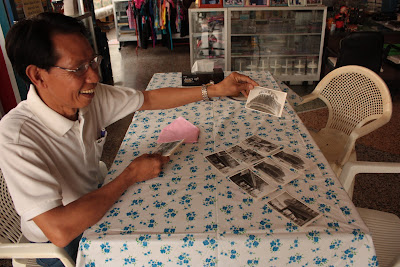
Chalong Praditsuwan stood poised, reflectively explaining the series of events which culminated in his theater's demise.
"Before they got greedy, the distributors used to split the profits with us. It was a fair deal and both parties prospered. But as time went by, the distributors figured they could make more money without the hassle of having to race around providing the film reels to all the different theaters. So they opened their own theaters. It didn't matter if their films only got a fraction of the audience they had before, because the revenue was all theirs. They didn't have to split it with the independent theaters anymore. Yes, they continued distributing to the independents, but not before charging a flat fee for the movie which we had to pay in full regardless if it made any money or not."
Other factors took their toll as well.
"On top of that," he proceeded, "the distributors stopped paying for advertising costs - like printing posters and buying space in the papers - and left that up to the independent theaters to do. We had to compete with each other for first dibs on the reels. Whoever put on a better advertising campaign was awarded the reel first. In Taphan Hin there were two other theaters, but mine was usually the first-run theater. I spent a lot, and the result was smaller profits"
With that, Chalong dug out some old photo albums, the contents of which revealed the colorful past of his now-dormant
Taphan Hin Rama. The 60 year old ex-theater owner happily recalled the various ad campaigns he staged in town to draw crowds to his enterprise. From four-meter high hand painted billboards, to horse caravans and costumed parades through the center of town. He even hired local
song taew drivers to pick up patrons at a designated spot and bring them to the
Taphan Hin Rama for free.
 Horses were hired to parade through town adverting a Thai Western
 Chalong hired a group of locals to don costumes and parade through town on a buffalo to advertise a Hong Kong period film.
 Ad campaign for the movie "Gold 2" featuring a motorbike with a hang-glider attached to it.
 My personal favorite, the audience before the start of a film. Notice how everybody is well dressed.
 On December 17th 1979, the Taphan Hin Rama had its grand opening, with 'Supersonic Man' as its debut film.
 Photos from opening day

"Each region of the country has its own distributors," continued Chalong. "All the small theater owners had to go through their regional distributors to get the films. Up here in northern Thailand,
Pranakorn Films is the distributor. Nobody else is allowed to distribute in the north. It's the law. Once Pranakorn Films started to open their own theaters under the name Thana Cineplex, that was the beginning of the end for us. They raised their prices and simply pushed us out of business. Believe it or not, at one point their was at least one theater in every district of Phichid. Now there's only the Thana Cineplex in Happyland Shopping Center in the provincial capitol. Nothing else. Pranakorn Films killed the independent theaters throughout northern Thailand. They really killed a way of life."
 The Taphan Hin Rama's dormant auditorium and screen
 Looking towards the rear of the auditorium. To the left of the projection booth is the glassed-off soundtrack room, for patrons who wanted to watch foreign movies in their original dialogue.
 The soundtrack room
The bluntness of Chalong Praditsuwan's explanation was refreshing. His critical angle was in contrast to most of the current literature on the subject, which tends to view the fall of Thailand's stand-alone and independent theaters as the inevitable result of changing consumer tastes and habits, without so much as mentioning the complicity of industry heavyweights in the process. In the case of
Pranakorn Films, aside from distribution and exhibition, they also produce movies. That combination makes them a vertically integrated business, which by its very nature stifles competition. The practice might pass as permissible if there were strong evidence that efficiency gains were being shared at least equally with comsumers, but that's obviously not the case. How could it be? Now if you want to go to the movies and you live in Phichid you've got to get all the way to the provincial capitol and pay a premium. That's definitely not efficient!
Across the globe and way back in 1948, the US Supreme Court won a landmark anti-trust case (
United States vs. Paramount Pictures) against the major Hollywood-based movie studios who had, over a period of time, developed their own theater chains to exclusively exhibit the films that they produced. The ruling forced the studios to sell off their theaters as a means of stimulating competition among theater owners. But more importantly, it forced them to come up with potentially better and more varied films for consumers to choose from. Maybe it's time for a case like that to be filed in Thailand.

But it would be unfair to pin the blame exclusively on the big, vertically integrated theater chains. Like Taphan Hin, smaller cities throughout Thailand have been suffering from weak economies and severe cases of brain drain for decades, with the majority of their capable young people running off to Bangkok or abroad in pursuit of careers, while abandoning their home town cinemas to childhood memory. Even Chalong's kids, now grown, have opted to reside overseas rather than settle down in little Taphan Hin and try to figure out ways to get the family business back on its feet.

In hindsight, it would be interesting to see what might have become of small town theaters like the
Taphan Hin Rama had the distributors been a bit more fair.


