
Tuesday, March 10, 2009
On the road
Out on a collection mission. Stay tuned for an expanded, ever more exciting archive of ailing theaters in Southeast Asia.

Tuesday, March 3, 2009
The Mae Sot Rama - Mae Sot, Tak, Thailand
The border town of Mae Sot in Tak province is less Thai than anywhere else I’ve been in the country. A bustling downtown is packed with migrants of Burman, Karen and Bangladeshi decent, complete with a Muslim quarter thronged with ramshackle tea shops. Second and third generation Chinese-Thai gem traders sell their goods from open-front shops and a sizable Western presence comes and goes to service the refugee industry centered around the town. But what do all these people share in common? Why of course, they no longer have a movie theater.
 But from the 1960's to the mid 1990's they had Mae Sot Rama to satisfy their escapist needs.
 I spoke with the daughter of the current owners, who now run the T-Corner restaurant just next to the theater. She claimed that "small town Thai economies have suffered for the past 10 years" and that operating the family gem was too costly. "We'd like to find a tenant," she added, "but the place is in bad shape and it would cost too much to fix. Tearing it down would also come at the high price tag of 100,000 baht."
 A poster case hangs ghostly in the lifeless lobby.
 But from the 1960's to the mid 1990's they had Mae Sot Rama to satisfy their escapist needs.
 I spoke with the daughter of the current owners, who now run the T-Corner restaurant just next to the theater. She claimed that "small town Thai economies have suffered for the past 10 years" and that operating the family gem was too costly. "We'd like to find a tenant," she added, "but the place is in bad shape and it would cost too much to fix. Tearing it down would also come at the high price tag of 100,000 baht."
 A poster case hangs ghostly in the lifeless lobby.
The Wiang Mai Theater - Mae Sariang, Mae Hong Son,Thailand
Comatose would be a fair description of Mae Sariang, dangling on the edge of the Yuam River in Mae Hong Son province. I loved it all the same. Its small town charm belies a rich history. Of what, I don't know. A Thai-Burma trading depot of yesteryear, maybe? Whatever built this city I was happy to find one old theater in town. Wiang Mai roughly translates to "new town."

 Apparently the place stopped showing films sometime in the mid to late 90's only to be reoccupied by the always-thrilling retail propane gas industry.
 I think that's Jackie Chan in the top left corner.
 Poster for Wong Jing's garbage "Return to a Better Tomorrow."
 A rarity, the lobby walls covered with movie posters...and full of gas.

 Apparently the place stopped showing films sometime in the mid to late 90's only to be reoccupied by the always-thrilling retail propane gas industry.
 I think that's Jackie Chan in the top left corner.
 Poster for Wong Jing's garbage "Return to a Better Tomorrow."
 A rarity, the lobby walls covered with movie posters...and full of gas.
Wreckers
The bane of this web-site!
 The sign says they demolish old buildings, factories and bridges. Not to mention you know what.
Monday, March 2, 2009
The Lamphun Theater
The ancient city of Lamphun, its origins predating Chiang Mai by close to 700 years, is minuscule in size. Excluding the industrial parks that have sprouted up on the outskirts of town, the city takes about 15 minutes to cross on foot. Just inside the old city walls, but well hidden within a warren of buildings, the ancient capital's lone film venue decays.
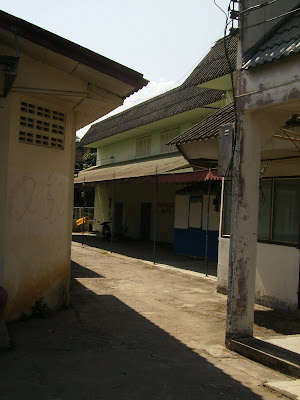 The Lamphun Theater is small, and being tucked away behind some buildings, down an alley, made it all the more difficult to locate. The building itself has few visible signs of what it once was.
 Former lobby
 The old ticket window
 The building caretaker, who'd been in a snooker hall next door when I arrived, explained how the Lamphun Theater used to draw crowds that lined up around the block to get in. "That was back when Lamphun's economy was good - in the 70's and 80's," he added. "Now Lamphun is just a transit city for folks on the way to Chiang Mai. It's hard to make a living here unless you work at one of those factories outside town."
 Coming Soon

 The screen survives
 The Lamphun Theater is small, and being tucked away behind some buildings, down an alley, made it all the more difficult to locate. The building itself has few visible signs of what it once was.
 Former lobby
 The old ticket window
 The building caretaker, who'd been in a snooker hall next door when I arrived, explained how the Lamphun Theater used to draw crowds that lined up around the block to get in. "That was back when Lamphun's economy was good - in the 70's and 80's," he added. "Now Lamphun is just a transit city for folks on the way to Chiang Mai. It's hard to make a living here unless you work at one of those factories outside town."
 Coming Soon
 The screen survives
The Chom Tong Two
As the world plunges ever deeper into economic asphyxiation, the question beckons: why did the tiny district of Chom Tong, Chiang Mai once have two movie theaters? Was it because of its position at the crossroads of southern Chiang Mai province, providing enough of a viewership and strong enough economy to support the two? Perhaps it was something as simple as the town having a cinemaphile resident with enough capital to toot his own horn twice. Whatever the case may be, both the Chom Tong Rama and the Poonthawee Cinema cease to function as theaters anymore.
 The Poonthawee Pappayon, opened in 1976 and closed in the late 80's.

 he current owner of the Poonthawee Cinema uses it as a warehouse for his wholesale dry goods distribution business.
 The Chom Tong Rama was the larger of the two. The current owners sell office and school supplies from the gutted theater.
 The Chom Tong Rama - The new store is called "Parinya" which translates to "comprehension."
 The Poonthawee Pappayon, opened in 1976 and closed in the late 80's.
 he current owner of the Poonthawee Cinema uses it as a warehouse for his wholesale dry goods distribution business.
 The Chom Tong Rama was the larger of the two. The current owners sell office and school supplies from the gutted theater.
 The Chom Tong Rama - The new store is called "Parinya" which translates to "comprehension."
Sunday, March 1, 2009
The Sang Tawan Theater, Chiang Mai's sole survivor
When approaching the intersection of Chang Klan and Sri Donchai Roads, a sense of loss pervades. Here on the southeast corner of this busy intersection rests the colossal of Chiang Mai cinemas, rotting mercilessly.
 Bound like a sedated hostage in the cheapness of billboards and advertisements, the sole surviving relic of Chiang Mai's movie-going glory days awaits an undetermined, likely grim fate.

 The facade of the Sang Tawan Theater boasted of an intricate mosaic depicting Lanna culture. Now it's hidden from the public eye, only a corner visible.


 Bound like a sedated hostage in the cheapness of billboards and advertisements, the sole surviving relic of Chiang Mai's movie-going glory days awaits an undetermined, likely grim fate.
 The facade of the Sang Tawan Theater boasted of an intricate mosaic depicting Lanna culture. Now it's hidden from the public eye, only a corner visible.
The three-tiered lobby languishes unused except as a toilet for vagrants...


...while the toilet houses only dust and cobwebs...

...and a majestic staircase leads to an abandoned balcony.
Subscribe to:
Posts (Atom)