Thursday, November 28, 2013

The Trisuk Theater - Khamphaeng Saen District, Nakorn Pathom Province, Thailand

Nestled in the heart of Khamphaeng Saen District's central market is a long forgotten piece of entertainment history. To be sure, the amnesia suffered this old building is not solely the result of the passage of time. Since its construction as a movie theater in 1973, the Trisuk Theater has served multiple functions - perhaps more than any theater previously featured on the SEAMTP. Keeping track of all its retrofits is enough to diminish the memory of its cardinal use. But low and behold, the design, gauge, countenance and style of this old building were all employed for the purpose of film.


Like many of Thailand's stand-alone theaters, the Trisuk was built in the middle of an open-air market. 


The former Trisuk Theater, now a parking garage and restaurant.

The architectural language of the Trisuk seems to be a play on its name. "Tri" is from the same etymological root as the "tri" in Western languages, meaning three. Add the suffix "suk," in this case meaning happiness or joy, and you get a rough translation meaning "Three Joys." Now look at the architecture of the building. There are three separate pinnacles to it; a central cornice and two wing cornices. The remaining poster case (below), moreover, has a triangulated top. A possible link between name and design?

Admittedly, this observation might be complete conjecture. But on the other hand, there could be a grain of truth to it.   


A leftover from the Trisuk's movie theater days: a frame for movie posters. 

What we do know for certain about the Trisuk was conveyed by a man who helped construct it back in 1973, later on working at the theater as the in-house poster painter. His wife now operates a small restaurant in what was once the theater's lobby.

Despite its original intent, movie exhibition was short lived at the Trisuk Theater. A mere 10 years after its opening, ticket sales had fallen off so much that the theater was gutted and turned into a swimming pool. Its owner, Mr. Somchai Tri-Amnak - whose family name was inspiration for the Trisuk's name - was apparently keen on supplying the good citizens of Khamphaeng Saen with some form of leisure activity. But the swimming pool, too, was unsuccessful.

Next, Tri-Amnak leased the former theater-turned-swimming pool to a supermarket operator. That lasted a while, but ultimately didn't work out. 

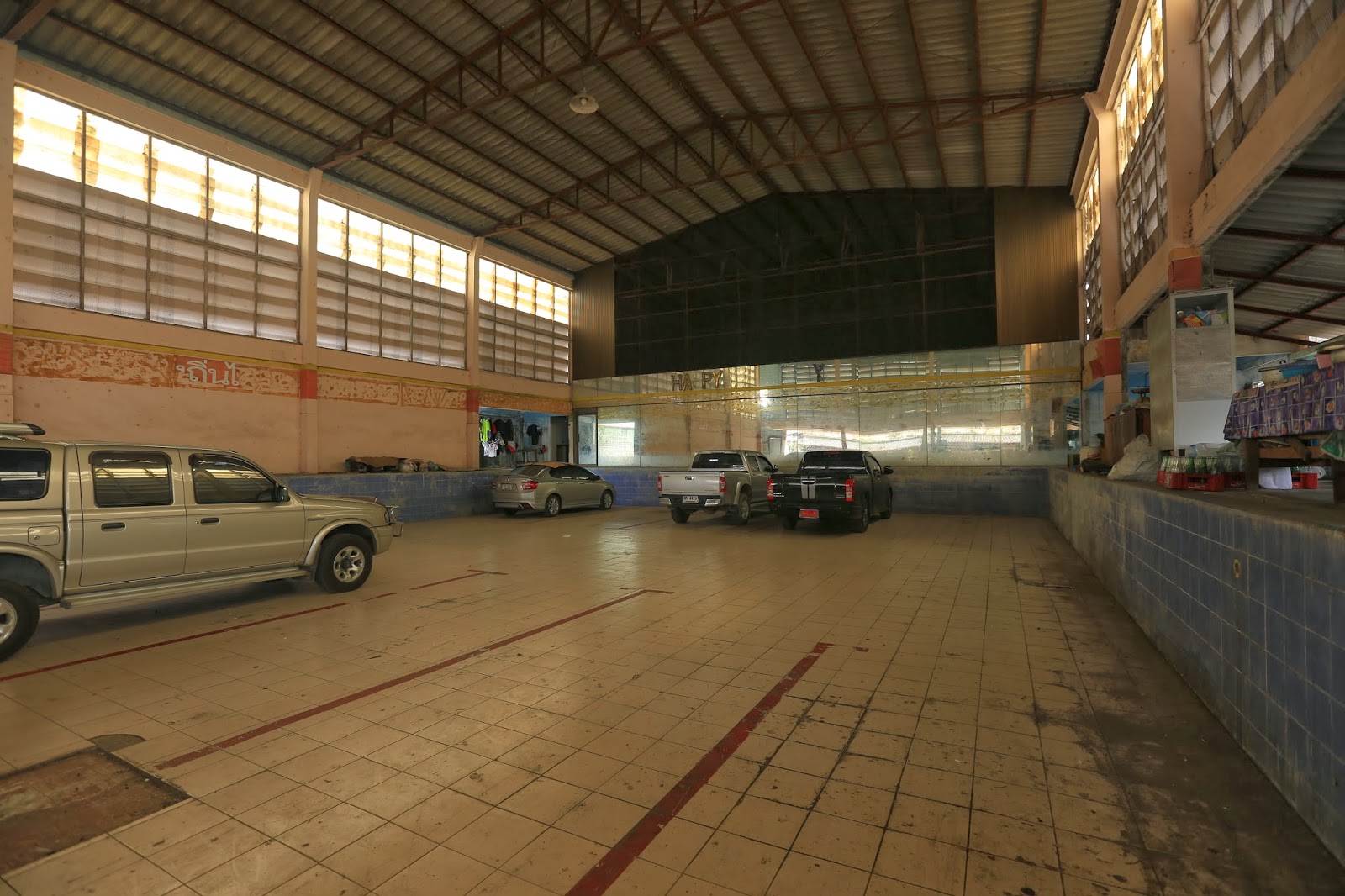
In the end the Trisuk was relegated to the lowest possible function that any building can have. Even lower than a latrine. More ignoble than a warehouse of soiled rags. The Trisuk is now a parking garage.
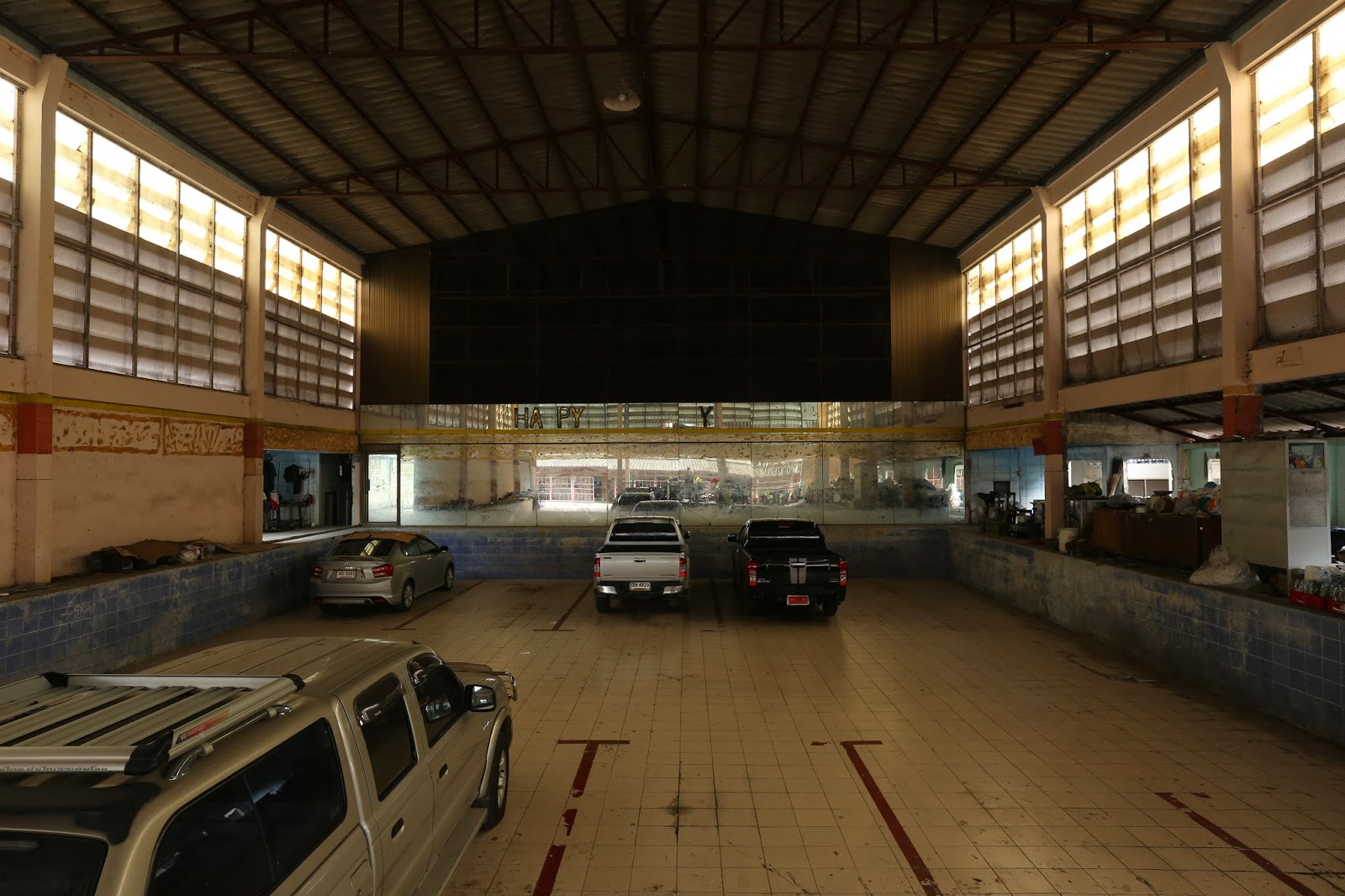

From movie theater, to swimming pool, to supermarket, to parking garage, with a bit of space for a restaurant.

Even in its current low-brow state, one of the more interesting dimensions of the Trisuk is that remnants of all its iterations are plainly visible at once. The mirror on the far wall, for instance, along with the red stripe circumnavigating the wall are leftovers from its supermarket days. 

The blue and white tiles on the lower half of the structure are the pool, basically as it was. 

All the exterior architecture is the Trisuk Theater in seminal form. 


Counter of the restaurant in the lobby.
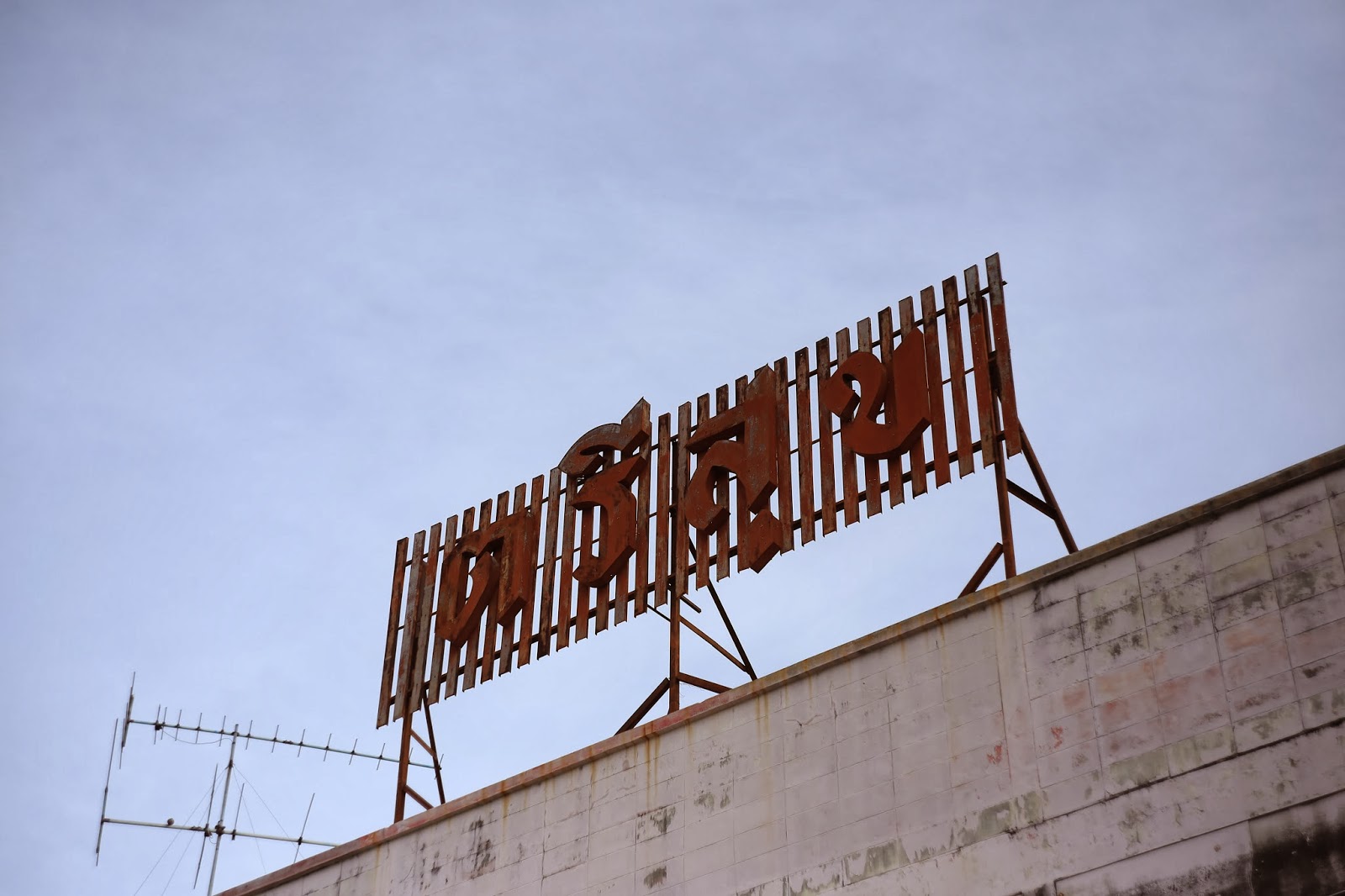

Trisuk signage


It seems unlikely that anything exciting will ever become of the Trisuk. Not in the foreseeable future, anyhow. As it stands now, however, with its exterior architecture in good condition, it gives a little clue as to a more lively past in Khamphaeng Saen. If nothing else, maybe somebody will derive a little inspiration from it.

Friday, November 22, 2013

Thai PBS catches up with the SEA Movie Theater Project

A news crew from Thai PBS met me in the town of Ban Pong, Ratchaburi for a short story on the SEAMTP. What they produced was broadcast this evening. 

Thursday, November 21, 2013

The Tang Sia Huad Rama - Nakorn Pathom, Thailand

"It smelled like slow death in there, malaria, nightmares" 

                                                                 - Captain Willard, Apocalypse Now


The third floor of the Tang Sia Huad Rama, once an area reserved for the storage of film reels and other notions of movie exhibition, is now home to festering piles. Anonymous piles, to be sure. Only their amorphous blackness was evident, and that they were inhabited by swarms of fleas that the strays had brought in. Whether the strays were animal or human wasn't immediately clear either.

Nearby shopkeepers in this crumbling quarter of Nakorn Pathom assured me that the cops had chased out the nefarious elements long ago. No more fiends tended to their addictions in the gangrenous warmth of the abandoned cinema. But the fleas. Yes, the fleas reign supreme. No sooner had I planted my feet in preparation for taking a shot than the fleas pounced on my exposed ankles, gorging themselves with reckless abandon.  My speckled legs glowed pink with poison as the fleas advanced higher.

On the far wall of the room, Al Pacino's head, in the role of Officer Frank Serpico, stared back at me from where it had been pasted decades ago. Testament to the theater's illustrious working days. Al - or Frank Serpico, I should say - gazed out mockingly. On second thought, maybe it was a look of pity. Outside the theater, the howls and cries of the local stray brigade could be heard. They were working themselves into a frenzy in advance of the battle they would bring to the invader of their den.             


Frank Serpico overlooks festering piles.


How to exit the cinema without incurring bloodshed quickly became my preoccupation. I doubted the hounds would enter the theater knowing I was inside. That would be too risky for them. It would be a waiting game from here on out. Once I stepped into the light of day, into the weed strewn patch of earth in front of the theater, that's when they would attack. Not in the close quarters of the cinema.

So I swatted the fleas from legs and went to work. As I scanned for decent angles and notable ephemera, I also scanned for objects which could serve as weaponry. There was very little to be found. A rusted knife, some broken chairs. Touching these soiled objects with bare hands seemed just as hazardous as the dogs they were meant to fight off. The best option, it seemed, would be to lock my tripod in its extended position. That four-foot length of titanium would at least allow me to keep them at bay as I moved toward the world of mankind.


In the mid-20th century, Thai movie theaters often employed live voice dubbers to act out the dialogue of foreign films, or Thai films shot without sound on 16mm film. This sign points the way to the Tang Sia Huad Rama's dubber's room.


The descent


Beauty in the bleak


Broken Windows theory.
  
The descent from the third level of the theater was made lengthy by several rounds of long-exposure photography. By the time I had reached the foyer the dogs had grown tired. Most of them had scattered. The two or three that remained by this time were dozing in the weeds. Occupational hazard number one successfully avoided.

Free from fear, the Tang Sia Huad Rama was my oyster. 


Veranda shots. 

As with most Thai theater lobbies, the Tang Sia Huad Rama's is open air, energy efficient and sustainable. Even in decay. 


Buddhist prayer paintings can be seen on the upper part of the door.


The upper sign says "It's forbidden to bring bags of ice into the theater."

According to a local merchant, the Tang Sia Huad Rama and its environs was erected in 1967. Originally, the mixed use commercial/residential development included a covered market as well. But like the theater, that too was long ago left to the dogs. 

The entire development, which covers an enormous swath of land is named for the builder - local business man Mr. Tang Sia Huad. Mr. Tang has since passed away. 

The current owner is the son of Mr. Tang Sia Huad. Generation number two has indeed inherited his father's business acumen, but apparently not the architectural vision. Among his many business ventures at present is licensed dealer for Isuzu vehicles for all of Nakorn Pathom province. By all accounts he's a wealthy man, but not so concerned about his father's built legacy.


The Tang Sia Huad Rama. It's rare to find a Thai theater in which the builder used his original Chinese name as the theater's official name.


Fading colors in a forgotten quarter.


So what accounts for the failure of this zone? Why, despite its centrality, has this been relegated to the status of bypass economy? Merchants and residents claim that it boils down to neglect. Plain and simple. The owner will not sell off the properties individually. Instead he collects rent while being lax on the upkeep.

Speculation is that he's holding out for the right offer from a major retailer, then will sell the entire property off to be redeveloped as hyper-market or shopping mall. Alas, then this community will be no more.


And so will mark the end of the Tang Sia Huad Rama - former centerpiece of entertainment in this forgotten corner of Nakorn Pathom. 

Wednesday, November 6, 2013

The Poonthawee Theater - Jom Thong District, Chiang Mai Province, Thailand

The Poonthawee Theater, on its own, is not architecturally significant. In so far as it is of a style that is no longer built, yes, it has some historical value. But beyond its antiquity, it is basically commonplace. The only truly distinguishing feature is the font used for the dimensional lettering of the sign.

There are other contexts, however, through which the Poonthawee's value increases and makes it worthy of long term care.


The loss of landmarks such as the Poonthawee Theater would have an adverse effect on the town's streetscape. 


Signage for the Poonthawee Theater

Jom Thong is a small town. The Poonthawee stands at a prominent location in the town center, directly across from Jom Thong's sacred Wat Prathat Sri Jom Thong Worawiharn. Abandoned or not, the old theater, complete in its decorative adornments like its signage and marquee, is a city landmark, almost equal in distinction to the ornate temple across the road.

By incorporating a prestige structure - even an outmoded one -  into a town's historical narrative, it brings continuity and value to place. Visually and intellectually, Jom Thong is a more dynamic place with the vacant Poonthaween Theater than without it. The task now should be to find some adequate secondary function that would utilize its space.

The loss of these buildings is a waste both of architectural heritage and material resources (it takes far more resources to demolish and build anew than to renovate or repurpose). As such, a major revision in the way that we view old buildings is sorely needed. This will require, among other things, the cooperation of various stake-holders. Not an easy task, but not an impossibility either. Up to this point there has been a severe lack of will when it comes to preservation. It's time to change that.

The Poonthawee Theater was contracted back in 1976 by a man of the same name. In addition to his theater, he was also a local film distributor. The theater closed in 1988 and has served Mr. Poonthawee's family as a warehouse ever since.

Tuesday, November 5, 2013

Tragedy strikes Suphanburi

The Southeast Asia Movie Theater Project has the unenviable task of announcing a great loss to Thai cinema architecture. A few days prior, news reached our desk of the demolition of the theater featured on this blog's title banner - Suphanburi's Fa Siam Theater.


The Fa Siam Theater, now no more

While precise details of the theater's history were not compiled during the cursory research trip made in late 2009, the Fa Siam was an unabashed visual spectacle. Soon after documenting it, the Fa Siam's image was beamed across the internet as the gateway to an on-line world of Southeast Asian movie theater fantasy. From then on, the Fa Siam received nothing but praise. Who know's how many casual visitors to this site were drawn in, not by the literary drivel herein presented, but by the striking architecture of the Fa Siam Theater that greets the eye.  For all intents and purposes, it has been this project's logo.

As movie theater architecture in Thailand goes, the Fa Siam was about as authentic as it gets: A highly stylized piece of modernism, derivative perhaps only of Bangkok's legendary Scala Theater (right). This, in fact, has long been a point of curiosity. Noting the architectural similarities to the Scala Theater, - modern palladian windows, tapered buttresses and zig-zag cornices - I've often wondered if the Fa Siam was also a product of the master of mid-century Thai modernism, Chira Silpakanok. Further research should yield that answer.


Lobby view

Regardless of who designed it, the Fa Siam was a work of architecture that ought to have been given a second life. Sadly, there is still a dearth of preservation-mindedness in Thailand when it comes to architecture. Old movie theaters, moreover, are basically considered trash in need of removal. Even a bona fide landmark like the Scala in Bangkok is on the demolition list.


Hawking at Lert Fa market in front of the Fa Siam.

In order for Thailand to raise its international profile, a reevaluation of how to treat old architecture is much needed, lest this dynamic country arbitrarily sap itself of its inventory of cultural capital.


Dimensional signage

To the people of Suphanburi: my heart goes out to you. While your unique Banharnist political system may be making you richer with each passing day, your quaint little town is much poorer in culture now that the Fa Siam is no more.

Tuesday, October 29, 2013

New things to come for the SEA Movie Theater Project

After 18 months of hiatus, the Southeast Asia Movie Theater Project is once again active. During this upcoming phase of the project, we promise to go a little further, to dig a little deeper in order to exhume more of the faded glory that is the stand-alone movie theater; its architecture and its culture in Southeast Asia.

Continuations in Burma and Thailand are on top of the "to do" list. As the economies of both countries are growing fast, a "down-with-the-old, up-with-the-new" attitude will find economy with each country's movers and shakers. Through the work done here, hopefully we can tweak that attitude just enough to salvage a bit of cultural history, movie theater style.

In the meantime, a few past steps have been retraced in Bangkok, making visits to theaters that have already been covered on this site. Here's the findings:


  • Back in 2009 we ran some shots of the Ratchathewi Rama, off of Petchburi Road Soi 12/8. 


"Closed for renovations"

Once part of the Co Brothers theater empire, headed by "Sia" Charoen Poolworaluk, by the time we got around to it four years ago it had recently closed and was undergoing a transformation into a parking garage. Here's the result:


Parking garage in full effect

Still, a few bits of movie theater ephemera remain.


"Coming soon" at the Ratchathewi Rama

  • Over on the west-bank Thonburi side of Bangkok, we found that the once-grand Hawaii Theater - originally documented in its later and less than salubrious guise of sex cinema back in 2009 - has closed up shop altogether. Given its proximity to the Wong Wian Yai BTS station, it is a likely candidate for demolition to make room for a condo tower. Transit oriented development (TOD), or the placing of dense housing developments close to public transportation facilities, is usually a good thing, but it will be a shame to lose this old movie theater.


The Hawaii Theater, shuttered.

  • But most importantly, after 44 years of serving the public's entertainment needs the Scala Theater at Siam Square is still Southeast Asia's premiere movie palace and looks great. Upgrading to digital projection late last year has improved the viewing experience at the Scala, adding one more reason to attend this one-of-a-kind movie venue.


The Scala Theater, Thailand's last movie palace.

A top priority of the SEAMTP over the coming months and years is to build up a Scala support network dedicated to advocating for this cultural icon to ensure that it is not demolished. When the theater's lease expires in 2017, Chulalongkorn University, the landlord of all of Siam Square, has plans to raze the Scala to clear ground for a new shopping mall. Such action would result in a severe loss to Thailand's cultural capital.


Saturday, October 19, 2013

Bangkok's claim to cinematic history

Below is the text of an op-ed I wrote advocating for the renewal of the Nang Loeng AKA Sala Chalerm Thani Cinema in Bangkok. Click here for the Bangkok Post version of it.


The Nang Loeng Cinema - Bangkok, Thailand
This past Wednesday, the world’s oldest cinema reopened for business after nearly two decades of dormancy. The 114 year old Eden Theatre, located in the French sea-side town of La Coite, was used by the motion picture-pioneering Lumiere Brothers to screen an early work of theirs. Over the next 90-plus years, the Eden fluctuated between being a movie and live theater before closing down in the 1995. Now, following a lengthy renovation process, the Eden is back in business as a full-time movie theater, with space set aside for a permanent exhibit dedicated to the origins of animated pictures.
With France now claimant to the oldest operating movie theatre in the world, Thailand is in position to stake claim to the oldest active movie theater in Asia. But that claim hinges upon a forgotten piece of cinema real-estate getting the same treatment as France’s Eden.

Nestled in a corner of Trok Nang Loeng, in the historic Rattanakosin area of Bangkok, stands the Sala Chalerm Thani Theater. More barn in appearance than cinema hall, the mostly wooden structure dates to 1918 when it was contracted by the Siam Cinema Co. under the name of the Nang Loeng Cinema


Signage announcing the theater's latter name, Sala Chalerm Thani, tacked to the facade.
In the late 1910’s, the Siam Cinema Co. became the country’s largest theater operator after two fierce business rivals – the Krungthep Cinematograph Company and the Pathanakorn Film Company – merged into one. The Siam Cinema Co. operated as many as 20 movie theaters in around Bangkok until the early 1930’s, when financial troubles caused them to sell all their theaters to the newly-formed Siam Niramai Cinema Co., making it the nation’s largest theater chain at the time. It was then that the name of the Nang Loeng Cinema was changed to the Sala Chalerm Thani. 
Without going into a detailed history, the Nang Loeng Cinema, or Sala Chalerm Thani – whichever you prefer – is a worthy candidate for a revival. Its unique architecture, historic location and nearly century-old age provide ample justification for that.

The architectural aspect boils down to the material it’s made from. While wooden theaters were the norm during the early days of motion-picture in Thailand, by the middle decades of the twentieth century they had become the rare exceptions. Only in the smaller towns and villages in the provinces did wood occasionally find utility as a building material for theaters. Over the years wooden theaters have all but disappeared, replaced by theaters built of brick and mortar or not replaced at all. The Nang Loeng Cinema is thus a rare example of Thai vernacular cinema architecture in the heart of the country’s primary city. 
The Bangkok Metropolitan Administration (BMA), Bangkok’s version of a city planning office, has been seeking ways to increase tourist revenue from historic Rattanakosin. Were the Nang Loeng Cinema to find a source of funding for a make-over it would be transformed into a fascinating and potentially lucrative destination. Try to envision daily tours to the Nang Loeng Cinema to screen a documentary film about, say, the history of Rattanakosin, or Bangkok in general. Visitors could then explore the ancient neighborhood, bringing revenue to local businesses in the process. By night, the 95 year old structure could be turned into an art-house theater, or live venue, drawing regulars from the ranks of Bangkok’s film and art sets. 
If done properly, a revival of the Nang Loeng could make it the cinema equivalent of the Jim Thompson House – a vestige of old Bangkok with both contemporary and historic functions.

As of 18 months ago, notices found tacked to the Nang Loeng’s façade announced up-coming renovations sponsored by the owning Crown Property Bureau – the financial branch of Thailand’s revered Royal Family. This would seemingly be the solution to the theater’s now twenty year-long stint as a storage space - an unfortunate use for such a significant structure. But when questioned about the notices, nearby residents said that they had been pinned up more than a year prior and nothing had happened since. Few in Trok Nang Loeng had any hope the renovation plans would be enacted.

The revival of France’s Eden Theatre as the oldest operating theater in the world should inspire a vision for “the oldest operating theater in Asia.”  In the Nang Loeng Cinema, Bangkok has the right inventory! An attraction of that gauge would add further value to Thailand’s cultural capital, and from a very unique perspective at that. Movie theaters, after all, are fairly universal, but wooden ones are almost unheard of.

As an investment into the economic viability of Rattanakosin, the revival if the Nang Loeng Cinema will certainly will not answer all of the BMA’s questions. It would, however, be one piece of the puzzle. The only thing that seems to be missing is the political will to get it started.