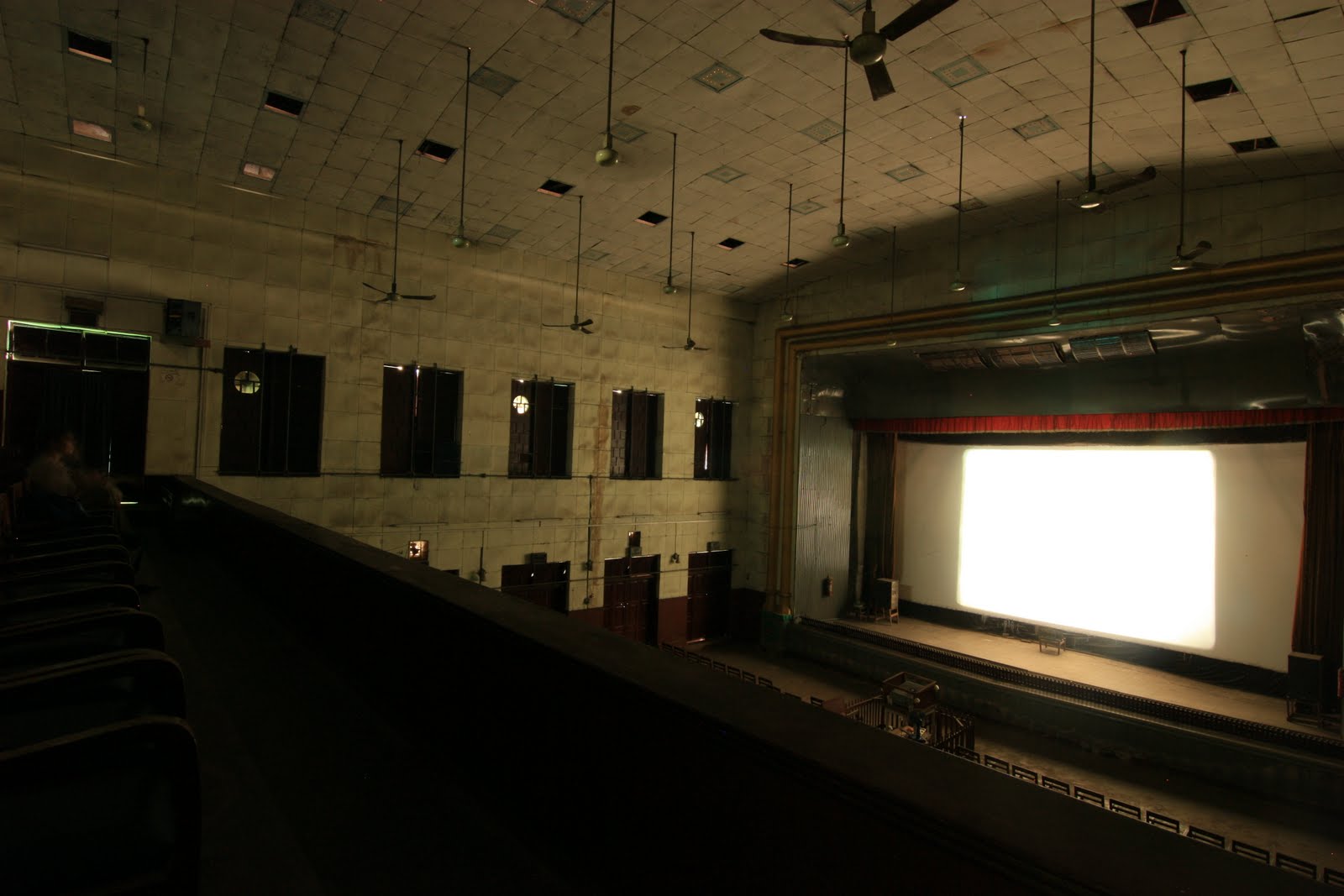
Some scholars in the field of Southeast Asian Studies have argued that it was the spectacle of theater which provided legitimacy for rulers of classical Theravada Buddhist-Hindu polities. To possess within ones domain, the theory goes, troupes of Ramayana performers was like having the heavenly deities personified on Earth. A ruler's awed subjects would readily adhere to state ideology after witnessing the acrobatics of the god circus. And further, the ability to produce such performers was testament to the power and sophistication of the reigning court.
Fast forward a few millennia: movies have supplanted live performance as the leisure-time activity of choice, and the movie theater serves as its temple. One decade into the 21st century and many of the original cinemas of Myanmar, unlike those in other Southeast Asian countries, continue to operate, if in a state of gradual decline. On the advice of my interpreter/travel companion, a veteran of Myanmar back roads, we decide to seek them in several of Magwe Division's more out-of-the-way cities. From our mosquito ridden hotel room in the eponymous division capital we plotted a route: directly east, to Natmauk. From there, south, to Taungdwingyi and then back to Magwe. A triangle of travel, both axes of which, we were told, contain a cinema.
Magwe Division lies in the geographic heart of the country. Its southern boundary with Bago Division marks the transition from "lower" to "upper" Myanmar, to use terminology popularized in 19th century British colonial descriptions. The "Dry Zone," another local moniker, encompasses much of Magwe Division. Annual rainfall here is far below that of most other parts of the country. In January, height of the dry season, the impression of a desert - almost caricature in appearance - strikes the hardest. Cattle trod emaciated through mostly-fallow paddy fields, their slightly better fed human caretakers a flog-length away. In this country of plenty, malnutrition is bountiful.
Two hours of rumbling along a sand-swept road in the back of a covered pick-up, San San Pwint and myself pulled in to the town of Natmauk. The immediate scene was one of transitory rush: always a bewildering welcome to the newcomer. Guided by a local woman whom San San had befriended en route, we were quickly led away from the pandemonium of the transit depot. Behind us, a clamor of motorized vehicles from bygone eras and horse-drawn wagons vied for space. Residential quarters lay ahead.
Walking in tow of the two Burmophones - one native, one foreign born - while they conversed in a language I could not understand, I resigned myself to the tourist's gaze, taking in the streetscape, scanning from side to side, building to building. More than a few of Myanmar's urban zones feel as if the city-building effort was abandoned, mid-stride, decades ago. Instead, it seems, people focused on the far more practical task of procuring a living. For all intents and purposes, that was the case. In cities other than Yangon, streets and sidewalks feel less decayed than halfway built. Natmauk's well-spaced houses and tree-shaded lanes, charming on the surface, obscure the fact that most public utility infrastructure does not exist. The sidewalk on which we strode was but a dusty patch between house and road.
Barely 5 minutes into our walk and a motorbike pulled up beside us. Another soon followed. The blue camouflaged helmets worn by their drivers gave them away. The gendarmes were upon us! Our crime was a given: we had trespassed; entered a town prohibited to foreigners. Expulsion was the likely punishment. At this point our guide quietly departed, wishing us the best as she tried to avoid suspicions of treachery. San San Pwint was left holding the torch, her wits and her ample experience in dealing with Myanmar's petty tyrants our only recourse. In anticipation of such encounters, she had prepared a story that was both non-threatening and partially true: we had come to this insignificant little town, not to document its movie theater - that would be so bizarre, so comically absurd as to be viewed with alarm - but to visit the birthplace of national icon General Aung San.
Natmauk is indeed the town that spawned the leader of Burma's independence movement, father of the country's most popular political aspirant, Aung San Suu Kyi. The son of a lawyer and from a family of outspoken nationalists, Aung San entered the world in Natmauk on February 13th, 1915. His childhood home, a modest teak structure with a pitched roof, is listed in some guide books as an open tourist attraction. Unless one is hunting movie theaters, it's ostensibly the only reason to visit Natmauk.
It was a genuine surprise that we were granted permission to go through with our stated objective. The cops even went so far as to drive us there on the backs of their motorbikes. But the house was closed when we arrived, completely shuttered, with a sign in English on the door prohibiting photographs. We stood in front of this national historic landmark feigning disappointment at not being able to get in, as the cops and San San engaged in what seemed like a lighthearted conversation. A small crowd drifted in to bear witness to the incredible Burmese-speaking foreigner.
Our last stop in Natmauk before the final act of expulsion was the back room of a dingy, smoke-filled teashop near the transit depot. Here the sheriff and his deputy recorded our information on a pad of paper. Names, passport numbers, visa numbers, hotel we were staying at in Magwe, all written down. More conversation ensued between San San and our captors, the translated version soon made available to me. Options were offered to us. We could get on the next train out of town, the next bus out of town, or they could arrange some form of private transport for us. They were kindly interrogators, and as San San Pwint later told me, by the time the conversation was through they were remorseful for having to expel us.
We never got to see Natmauk's cinema.
The stuffy paranoia experienced in Natmauk is a byproduct of a regime mistrustful of everything and everyone. It is deeply ingrained in the law enforcement culture of Myanmar. In smaller towns, the goal of the local authorities when faced with foreigners is simply to move them out of their jurisdiction, regardless of where to, as quickly as possible. Once free of this burden, culpability is lifted and the anxiety of the security threat dissipates. Out of sight, out of mind. Responsibility is delegated. Nobody wants to be held accountable for harboring the enemy.
The paranoid surveillance of officialdom is compounded in Magwe Division the by the presence of civilian informants. These local nuisances seek monetary rewards in exchange for their patriotic whistle-blowing. Unfortunately, they featured prominently on the next leg of the trip.
The next stop on our itinerary was Taungdwingyi, where within ten minutes of our arrival immigration officials had tracked us down and told us to be on the next bus out of town. Though wholley disheartening to be thrown out by the authorities, because of the ineptitude of local informants, the expulsion process had a comic feel to it. Generally speaking, these characters proved themselves to be more blithering opportunists than a network of professional spies. San San Pwint, moreover, was skillful at crushing their spirits if they tried to intimidate us. The most memorable such incident occurred on the main road in Taungdwingyi, when a man approached us and demanded we write our names on a piece of paper. Unable to produce any identification proving he worked for a government agency, San San shredded the paper, handed it back to him and gestured for him to get lost. He thanked us politely for the handful of trash and our kindness.
Informant buffoonery notwithstanding, the suspicious stares and ever apparent xenophobia in Taungdwingwi were reason enough to curtail the theater search. This was the second town in a matter of hours in which we were more or less chased out of. The below photo of the
Shwe La Min Cinema, taken on the slide before packing it in, was all I got from this tour of rejection through central Magwe.
 A hastily taken shot of Taungdwingyi's Shwe La Min Cinema, the only image produced during a day-long trip through Magwe.

 The Busan Cinema Center
 Busan. International. Film. Festival.
 Funding for the Busan Cinema Center was largely shouldered by the municipality of Busan. As proof of its commitment to civic engagement, a 4,000 seat open air theater comprises the most dramatic of viewing options. This is where the opening and closing ceremonies of the festival, along with the awards ceremonies, took place.
 Movie-goers en route to the Busan International Film Fest (BIFF) and the inaugural run of the Busan Cinema Ceneter.
 The above photo depicts the entrance to the Cine Mountain, the main functional portion of the Center, housing four auditoriums on three levels. I was only able to enter one of the auditoriums during my visit: the 841 seat, triple tiered Haneulyeon Theater - a multipurpose auditorium, just as well suited for concerts and live performance as it is film. Elegant wooden seats topped with cherry red cushioning echo the red balcony surface, which wraps around the side walls of the theater like a ribbon.
 Sloping walls.
 Entering the lobby of the Cine Mountain, into a sleek world of film.
 A glass enclosed elevator brings movie-goers to the second and third floor balconies of the Haneulyeon Theater.
 Elevated view via escalator
 The upper levels of the Cine Mountain hold three auditoriums: one medium sized and two small. These three auditoriums will hold regular commercial screenings year round when BIFF is not using them.
 Upper lobby lounging
 Concession lines
 The crowning part of this entire experience for me was having a collection of SEA Movie Theater Project images beautifully displayed in the lobby of the Busan Cinema Center.


 In a post-modern sense, the Busan Cinema Center does for Korea what the Sydney Opera House does for Australia: it confirms, definitively, a level of commitment to the arts and culture, and an inspired disposition for the entire world to see. It creates a recognizable emblem. But ultimately, it lifts Korea and its film industry onto the world stage. A well done and well deserved achievement.