On the main drag of downtown Yala, just a stones throw from the city's lone cineplex, a classic mid-century movie theater stands partially buried behind a frontage of cheap new construction. Fortunately the concealment is only partial, giving the observant passerby a chance to notice the telltale fin sign jutting skywards off of the building's cubist concrete facade.
From the street, much of the Luna's facade is obscured by a new, frontal addition.
Neon letters spelling "LUNA" in English, Chinese and Thai span the vertical length of the sign, paying quiet homage to the theater's past.
Luna signage
The Luna Theater was built in 1960, at the height of the International Style movement in architecture. The builder was apparently a Singaporean transplant, which might explain why it has an uncommon aesthetic for a Thai theater (have a look at these Malaysian theaters for comparison).
Old Luna stayed in business until the mid-1990's, after which its auditorium was gutted and turned into a parking garage. Nothing therein remains that's worthy of documentation.
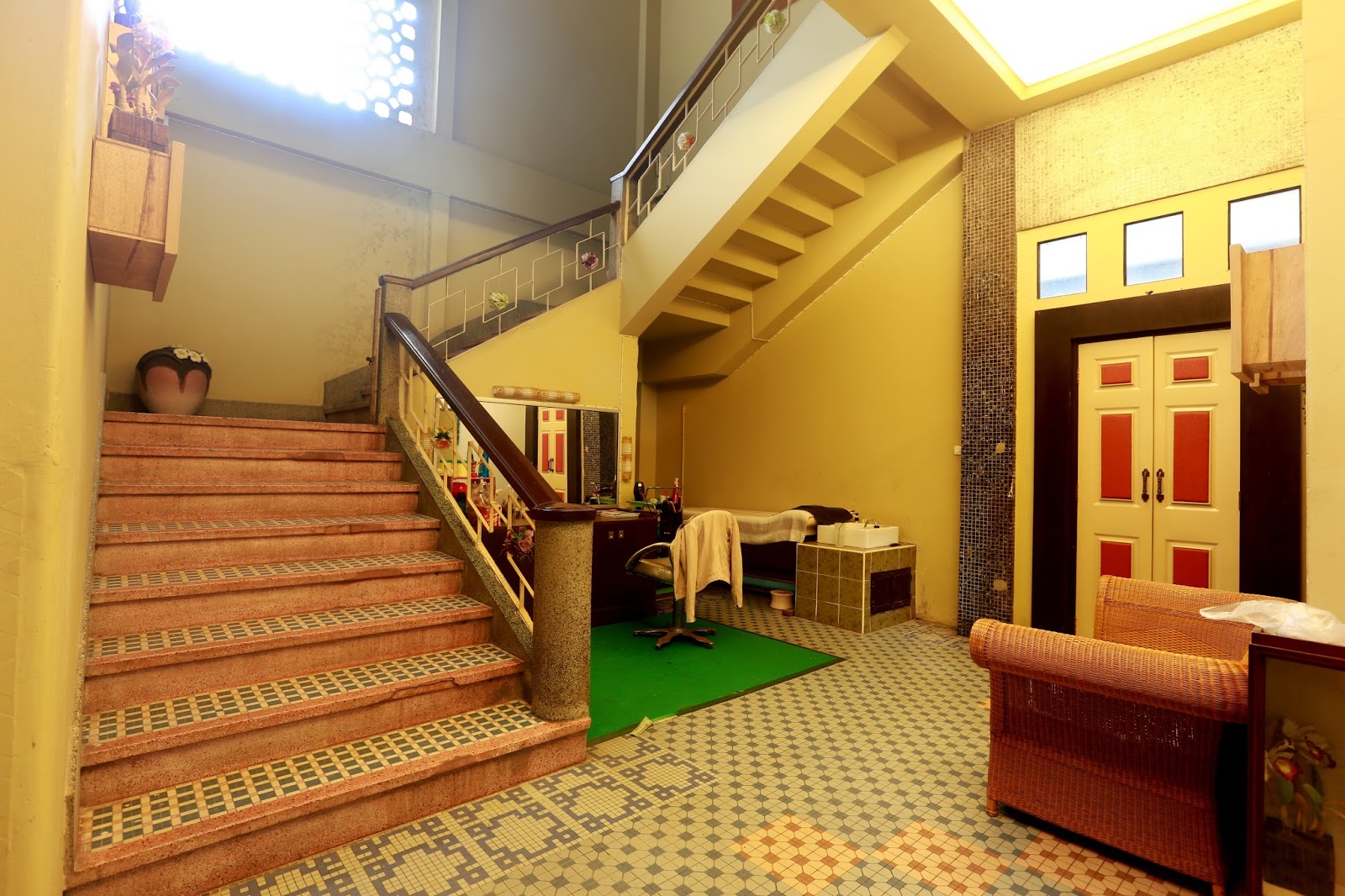
Parts of the lobby, fortunately, have been spared the hatchet, allowing the decorative details to remain visible for all who enter. In particular, the right lower lobby and accompanying staircase, which once led movie-goers up to balcony seating, seems to be fairly well preserved. If this colorful little sliver of preservation is any indicator, the Luna must have been a sight to see.
The Luna lobby, now part of a spa facility
Tiled flooring and stair in the lower lobby.
In its current iteration, the Luna Theater has been largely given over to a beauty spa. For this, the owner has smartly made use of the old theater's decorative lobby splendor. Beautification of the female form in an artfully designed cinema lobby: What a combo!
Ascending the wrap-around staircase like countless movie-goers from decades passed.
Inside the projection room.
Like a pair of rusted cannons on a forgotten battlefield, the Luna's carbon-arc projectors stand as a hidden reminder of the past.
Diesel generator, suggesting that Yala City did not have a steady electricity supply when the Luna Theater was built in 1960.
Luna signage - more akin to theaters from neighboring Malaysia/Singapore than Thailand.
Last week, at the invitation of a professor of philosophy from one of Bangkok's finest universities, I gave a talk about Thai movie theaters - past and present - and the nature of my work. It was a relaxed, informal talk, given to an active little class of about 25 students, all of whom politely endured a lecture in woefully bad Thai.
Before the students arrived, however, the professor and myself sat around talking movies, movie theaters and all things related. One bit of the conversation stood out in particular, so while its still fresh in my mind let me circumvent the actual order of my research to bring you this interesting missive from the annals of Thai movie theater history.
The IndraTheater, long abandoned in the heart of Nakorn Sri Thammarat
Said professor hails from Nakorn Sri Thammarat, southern Thailand's 2nd biggest city. A city which, in decades passed, surged with energy thanks to a quintet of massive stand-alone movie theaters huddled together in the heart of town.
The professor's invitation for me to speak to his class was inspired by a photo I posted of the Indra Theater - one of the downtown cinema halls in which he often took sanctuary as a youngster. Predictably, the Indra was the main focus of our talk.
From the many Hollywood classics the professor recalled watching at the Indra, our conversation evolved into one about the erstwhile profession and forgotten talents of the live movie dubber, once a staple of the Thai cinema industry. These live voice actors would entertain movie-audiences in real-time, lending Thai language to foreign films and dialogue to Thai films shot on 16 millimeter (which lacked an in-film audio track).
By many accounts, the dubber was the most important component of the Thai cinema spectacle. A good one could be more of a crowd pleaser than the actual movie stars in the film.
The key to being a good dubber, I've been told, the most important trick of the trade, was the ability to improvise the on the spot, tweaking the characters, or even the plot to make it slightly more relevant to the local audience. For instance, if the dubber was from the same town or region that the theater was in, he or she might speak in the local dialect, or even adapt characters in the film to represent local personalities.
The IndraTheater and its streetscape.
No story of a dubber at work has ever been more insightful than the one that the professor related to me last week before the start of his class.
The year was 1973 - a particularly volatile year in Thai history, best remembered for large scale student protests against a corrupt, dictatorial regime and the violent military crackdown which ended them. Into this context of heightened political tension, with the flames of "people's power" burning hot, Sidney Lumet's iconic police drama "Serpico," starring the wildly popular Al Paccino in the title roll, opened at the Indra Theater.
Thai version of the Serpico poster
Serpico, for those who aren't familiar, is the Hollywood account of real life New York cop Frank Serpico's political lynching at the hands of the New York City police department. In the film, as in real life, the upstanding bobby refused to take kickbacks from local criminal organizations, the going trend among many in the NYPD of the times. By shunning the practice and serving as a whistle blower against police corruption in general, Frank Serpico drew the wrath of the entire New York police bureaucracy. He almost got himself killed in the process.
According to the professor, Nakorn Sri Thammarat in the early 1970's had a similar problem with its own police force. Many officers had a acquired a base reputation for corruption, extortion and other forms of constabulary graft. Local grievances against the police were high on account of it. So when Serpico made its premiere at the Indra Theater, sympathetic crowds showed up in droves.
The ticket booth and lobby of the Indra Theater, now littered with debris.
Among Nakorn Sri Thammarat's more famous dubbers of the time was a man named Sirichai. According to the professor, Sirichai was a master at rousing a crowd. Whether the movie was foreign or Thai, for example, Sirichai always reserved his southern Thai accent for sidekicks and supporting characters, much to the amusement of the southern Thai audience.
But Sirichai's greatest talent was his deft ability to tweak a film's plot and characters to sync with contemporary Thai issues. He had a penchant, moreover, for using his role as dubber to address the day's top political scandals, both at the national and local level. And corrupt politicians were his number one target.
With Serpico, making political satire for Sirichai was like shooting fish in a barrel. It turned out to be his voice-over Magnum Opus.
Refuge from rain in the Indra's abandoned lobby
The crooked cops in the film were all given names corresponding to Nakorn Sri Thammarat's most notorious lawmen. The crowd, well aware of who was who among the city's police ne'er-do-wells, reacted with cheers and hysterical laughter at the associations the dubber made. The on-screen cops and the cops on the streets of Nakorn Sri Thammarat, if only for a few hours, became one and the same in eyes and ears of Indra Theater patrons. From the rank and file right up to the top brass, no corrupt member of the local police department was spared Sirichai's adaptive lampoonery. The crowd went wild, apparently, and because the film's initial dubbing session was recorded on tape for use in later screenings, multiple crowds were exposed to Sirichai's crusades.
The Indra auditorium. Ghostly voices of Sirichai's Serpico can almost be heard echoing throughout.
Not everybody got a kick out Sirichai's antics, however. As the professor explained, the dubber's satirical Serpico adaptation got him slapped with a libel lawsuit, which he ended up being found guilty of.
But as so often happens in these sorts of cases, the lawsuit martyred him, making him into a local hero and even more popular among movie-goers in Nakorn Sri Thammarat.
The sign for the Indra Theater, stashed away inside the ticket booth.
Sirichai's career as a movie dubber came to a close with the decline of Nakorn Sri Thammarat's stand-alone movie theaters, as it did for all of Thailand's once illustrious voice actors. But for this local personality, the experience he had gained from working a crowd of movie-goers was parlayed, ironically, into a career in politics.
Sadly, he died prematurely, before his political career had a chance to bloom.
Today, it's hard to imagine that the now-abandoned Indra Theater played host to this fascinating episode in Thai cultural history. Sirichai's Serpico.
Traveling to these theaters and digging up this history is very fulfilling, but it ain't cheap. You can to play a role in their continued documentation get a great little memento at the same time. Here's how:
For a small donation of $6, you'll be mailed these two original movie tickets from Nakorn Sri Thammarat, Thailand. The white and blue ticket was a VIP ticket to from the Wirote Rama Theater, which is still standing the heart of downtown. The yellow ticket was for open air movie screenings held throughout the province.
Supplies are limited, as no theaters in Thailand print such tickets any longer, so get yourself these unique movie theater keepsakes while supplies last. Just click the Paypal button below:
Ticket for the Wirote Rama Theater
Ticket for outdoor movie screenings in Nakorn Sri Thammarat
Picture, if you will, Thailand in the mid-1970's. In fact, lets make it an even 1974, for relevance sake. The country is firmly on the path to industrialization, particularly in the realm of industrial agriculture. Think canned fruits and fish and massive amounts of rice to be exported across the globe.
1974 also marks the second to last year that the United States waged wars in Vietnam, Laos and Cambodia. For the duration of the war, the US and Thailand had entered into a "strategic partnership" characterized by large transfers of military assistance and development dollars from the US in exchange for the use of Thai military facilities. This was the quintessential case of the Arsenal of Democracy arming a right wing regime on the front lines of Communist
Six Thai Air Force bases served as staging grounds for American planes to fly aerial assaults over Indochina. One of those bases, U-Tapao Air base, was located on the western edge of Rayong Province, along Thailand's then rapidly industrializing eastern seaboard (it is now fully industrialized).
With soldiers and technicians and all the accompanying service jobs that sprang up alongside the air base, the climate was ripe for a state-of-the-art movie theater to serve this military ecosystem. And so, in the nearby town of Bang Chang, the Burapha Theater was born.
The Burapha Theater - a stand-out among Thai stand-alones.
Side view of the Burapha Theater's sizable headhouse, which includes ticket booths, concession stands within multi leveled lobby.
Support columns in the lobby of the Burapha Theater are made of concrete, but sculpted to resemble trees.
The Burapha Theater was brought into existence by Mr. Somphong Chotiwan, who, by 1974, was already a well established figure in the movie exhibition industry of Bangkok and Eastern Thailand. Being based out of the much older Nang Loeng Theater in Bangkok, his birth place, and nerve center of Thailand's film industry, also made him well situated to be a movie distributor. His company, Meung Chol Films, had grown into the biggest distributor of films in eastern Thailand.
Then as today, movie distributors divided Thailand up into regional zones in which only select companies could operate. Each distribution company would purchase the rights to a film from the various production houses, usually headquartered in Bangkok, and then circulate it to theaters within their respective networks.
Some distributors built their own theaters, or purchased preexisting theaters within their network, thus eliminating the need to share profits with independent theater owners. This practice was fairly common, and for successful film exhibitors, it became a fast track to empire.
Three levels of lobby at the Burapha Theater
Old poster display on the third level of the theater
View of the "Soundtrack Room" where American Air Force pilots once comprised the chief clientele. A glass wall separated this room from the rest of the auditorium.
By the early 1970's, the town of Ban Chang had been feeling the economic benefits of its proximity to the U-Tapao Air Base for years. Awash in money thanks to a base full of foreign soldiers, cutting-edge leisure facilities were a necessity. The town already boasted of two active theaters, one of which - The Ban Chang Rama - was owned and operated by Sompong Chotiwan. But the resident English speaking population over at the air base were at a linguistic deficit when it came to watching movies, even when the movies themselves were American made.
Until the mid-1980's, most Thai theaters employed live voice actors to give foreign movies a Thai voicetrack. To do this, original in-film soundtracks were muted while dubbers read from a Thai script that was written to fit the plot. Often times story lines were modified to suit Thai tastes, or the dialogue improvised on the spot. For the Thai movie going public, a good dubber was an essential part for the movie going experience. For non-Thai speakers, however, it made the films inaccessible.
Necessity being what it is to invention, Thai theater entrepreneurs accommodated their English-speaking clientele by building "soundtrack rooms." Such rooms were small, air-conditioned seating sections behind a large glass windows, into which a speaker system separate from the main auditorium brought the original language soundtrack. Spectators therein could watch the film along with the rest of the audience while enjoying the original soundtrack. Down below, the Thai dubbers were working their magic. Everybody, as a result, was happy
Looking towards the screen from the Soundtrack Room
With the Burapha Theater, Sompong Chotiwan had not only built the largest, most luxurious movie house Ban Chang had ever known, he also ensured that the American soldiers stationed at U-Tapao Air Base were able to partake in the cinema experience without losing the plot.
One of the theater's former employees recalled American airmen renting little bungalows that were then in the vicinity of the theater when on leave. "They'd stay in those bungalows for a few days at a time," he explained, "usually with their 'lady friends.' At night they'd come watch movies at the theater before going out on the town."
Auditorium in full view.
The soundtrack room can be seen at the top rear of the Burapha's auditorium.
Like phantoms of movie-going passed, seats still remain in the Burapha Theater
Burapha Theater dimensional signage
By the middle of 1975, the US had officially ended its wars in Southeast Asia. Soldiers, technicians and all other military personnel stationed at Thai bases were shipped back to the States, along with all their cohorts in Laos, Cambodia and Vietnam. Just like that, the soundtrack room of the Burapha Theater lost its biggest client base.
But despite the loss of Americans, the Burapha Theater continued to do brisk business throughout the 1970's, 80's and into the early 90's. By that time, broader changes in Thai society were starting to make stand-alone movie theaters like the Burapha unprofitable.
One by one, these graceful giants of modern architecture went out of business, as the movie-going masses in Thailand capitulated to the convenient, but spiritually barren multiplex theaters located in the new shopping malls. The rest, as they say, is history.
The Burapha Theater screened its final film in 1995.
If you want to see the Burapha Theater for yourself, it can be found within the central market area in the heart of Ban Chang City, Rayong Province, Thailand.
Want to own a unique keepsake from Thai movie theater history AND support the Southeast Asia Movie Theater Project at the same time? For a very small donation of $6 you'll be mailed an authentic movie theater ticket from the Scala Theater in Surathani, Thailand. These tickets were hand stamped from 1988 and feature the theater's classic retro logo. Had I not salvaged them, they would have eventually been destroyed
Proceeds from each ticket will go directly to continued movie theater documentation in Southeast Asia, ensuring that a record of this unique cultural history will survive in the public domain for all to enjoy.
Ladies and gentleman, last month I salvaged several books worth of original movie tickets from the Scala Theater in the town of Punpin, Surathani Province, in southern Thailand.
The tickets, which are all hand-stamp dated January 14th, 1988, were discovered in a dust covered cardboard box in what was once the projection booth of the now abandoned movie theater. Miraculously, they are in mint condition, as if they had been carefully stored in a climate controlled vault for the past 27 years. Had I not grabbed them, they would almost certainly have been thrown in the garbage at some point down the line.
For a small donation of $6 dollars, you can have one of these great little keepsakes mailed directly to your home. Each ticket will be mailed in a durable plastic slip, which will also allow you to display the ticket handsomely should you choose to do so.
Thai movie theaters do not print tickets like this anymore. Nowadays, all movie tickets in Thailand have a generic, computer generated look. The tickets being offered here, however, feature the beautiful logo of the Scala Theater, along with the 10 baht ticket price, address of the theater, serial number and - as mentioned above - the hand-stamped date of January 14th, 1988
Your $6 dollar donation will not only buy you a great memento, it will directly support the continued documentation of stand-alone movie theaters in Southeast Asia. In fact, $6 dollars can very easily afford a bus ticket to a town where there may be a forgotten stand-alone movie theater that has never been properly documented.
To make the purchase, just click the "Pay Now" button below.
ATTENTION: These are not active tickets. They will not get you into see a movie. The theater that they are from is abandoned. They are authentic tickets from the 1980's
Also, this is not the same Scala Theater in Bangkok. There is no affiliation beyond the name.
There's something about the Dara Theater. It's hard to say exactly what it is, but something about it, as it stands today - all weathered and soot stained and forgotten - that places it not only from another time period, but from another world altogether. The Thailand of today, so absorbed in consumerism, distracted by smart phones and gadgetry and completely beholden to the car or motorbike for movement, seems as if it would have never had time to waste on such a building.
Street view of the Dara Theater
Tropical mid-century modernism at its finest. The Dara Theater hovers delicately beside the road. Its mounted marquee, appearing perky and weightless, sits atop an equally weightless looking portico.
The Dara as viewed from an adjacent roof top.
Even in a relatively small town like Trad, the Dara Theater seems like a structure that only an alien race would have erected. A temple to the gods of cinema, perhaps. Genuflections before the alter of the silver screen.