Showing posts with label Thailand - Nakorn Pathom. Show all posts

Friday, December 6, 2013

The Khampaeng Saen Rama - Khampaeng Saen District, Nakorn Pathom Province, Thailand

"Fifteen theaters were built throughout Thailand in this exact same style," he said, pointing in the direction of the abandoned behemoth at the far end of the field. Juxtaposed against the surrounding structures - dingy, mostly one-story shop houses - the citrus-hued theater glowed like the final minutes of a tropical sunset.    

He continued:

"The architect started with one theater. That one was a success, so he got more commissions, reusing the original blueprints again and again for a total of fifteen times. But the only other one I know of for sure is in Ubon. Or maybe it's Yasothon. I can't seem to recall."

Mr. Samaan, former manager of the Khampaeng Saen Rama and current neighbor to it, cycled through a list of facts and figures about his former place of employment. In the 80's and 90's he rented it from its owner, overseeing the day to day operations from the procurement of movies, to promotion and exhibition. Being the only venue in town since the rival Trisuk Theater went out of business, Mr. Samaan had under his supervision the lone ticket to another world - a fact he was eminently aware of.

A blast of color, the Khampaeng Saen Rama

Being the second theater to be commissioned in the town of Khampaeng Saen, the Khampaeng Saen Rama was the more luxurious of the two. This dichotomy of comfort had an almost immediate effect upon the older Trisuk Theater, tucked away in the town's central market.

When the Khampaeng Saen Rama opened in 1982, it is likely that the town's movie-going market become over-saturated, leading to a decline in ticket sales at the older Trisuk Theater, which closed down soon thereafter.

The difference in location also played a critical role in the Khampaeng Saen Rama's survival over the Trisuk. In the early 1980's, Thailand's industrial boom was just beginning to take off. The wealth created by the boom led to a further proliferation of private cars into the country - especially in the central provinces where most of the industry was situated. New car owners, pining to show off their hot new wheels with a trip to the movies, would have found parking difficult in the close quarters of the central market, where the Trisuk Theater stood. The Khampaeng Saen Rama, on the other had, was built just on the outskirts of town, along the highway leading towards the provincial capital and beyond. Parking was abundant in the surrounding fields, thus making a trip to the pictures less of a hassle. 


Dwarfing surrounding structures, the Khampaeng Saen Rama.


Concession stand beneath the theater, stairs leading to the lobby.


Ribbon windows allow natural light to flood the lobby, while aiding the vines in their quest to colonize.


Left over lobby cards for the 1998 Wong Jing comedy "The Conman," starring Andy Lau.


Ticket window


A mere 25 baht for tickets at the time of the theater's closure in the early 2000's.


Inside the ticket sales room.


Bathroom art: Men's Room


Bathroom art: Women's Room


The equipment room was covered in graffiti, most of which related to movies screened at the theater. One could spend hours reading it all.


Gutted auditorium, once home to 400 seats. A VIP room was located at the rear.


Manager's office with left over Jackie Chan movie poster on door.


Bold signage

Samaan spoke reverently about his old work haunt, recalling capacity crowds for both movies and live concerts alike. 

"It was a lively place in its day," he mused. "There were times when the crowd would erupt with excitement or laughter; cheering and jeering for heroes and villains; swaying in their seats, or jumping out of them altogether. Running the place made me feel responsible for all those emotions."

At some point in the late 80's, the Khampaeng Saen Rama was acquired by the Fred Films circuit, a Bangkok-based second-run theater chain owned by Mr. Fred Banpreecha. But following a reorganization of the national movie distribution system, whereby the country was divided into exclusive territories between a handful of companies, the notorious Thana Cineplex circuit - subsidiary of Pranakorn Films - came to control the market in west-central Thailand. Known for the usurious business practice of charging a flat fee for each film instead of the standard revenue split between theater operator and distributor, Thana helped ensure further decline of the Khampaeng Saen Rama, which was already struggling against a rise of home entertainment consumption.

By the year 1999, the Khampaeng Saen Rama was through, ending a brief but bright run as Khampaeng Saen's cultural heart. 

Like many formerly shuttered theaters in small town Thailand, it was given a brief revival in 2001 to screen the royally-backed epic Suriyothai, before once again falling dormant.

As for the remaining 14 theaters throughout Thailand built in the exact same style as the Khampaeng Saen Rama, this is something to be on the look out for. That is, if any still exist. 

Thursday, November 28, 2013

The Trisuk Theater - Khamphaeng Saen District, Nakorn Pathom Province, Thailand

Nestled in the heart of Khamphaeng Saen District's central market is a long forgotten piece of entertainment history. To be sure, the amnesia suffered this old building is not solely the result of the passage of time. Since its construction as a movie theater in 1973, the Trisuk Theater has served multiple functions - perhaps more than any theater previously featured on the SEAMTP. Keeping track of all its retrofits is enough to diminish the memory of its cardinal use. But low and behold, the design, gauge, countenance and style of this old building were all employed for the purpose of film.


Like many of Thailand's stand-alone theaters, the Trisuk was built in the middle of an open-air market. 


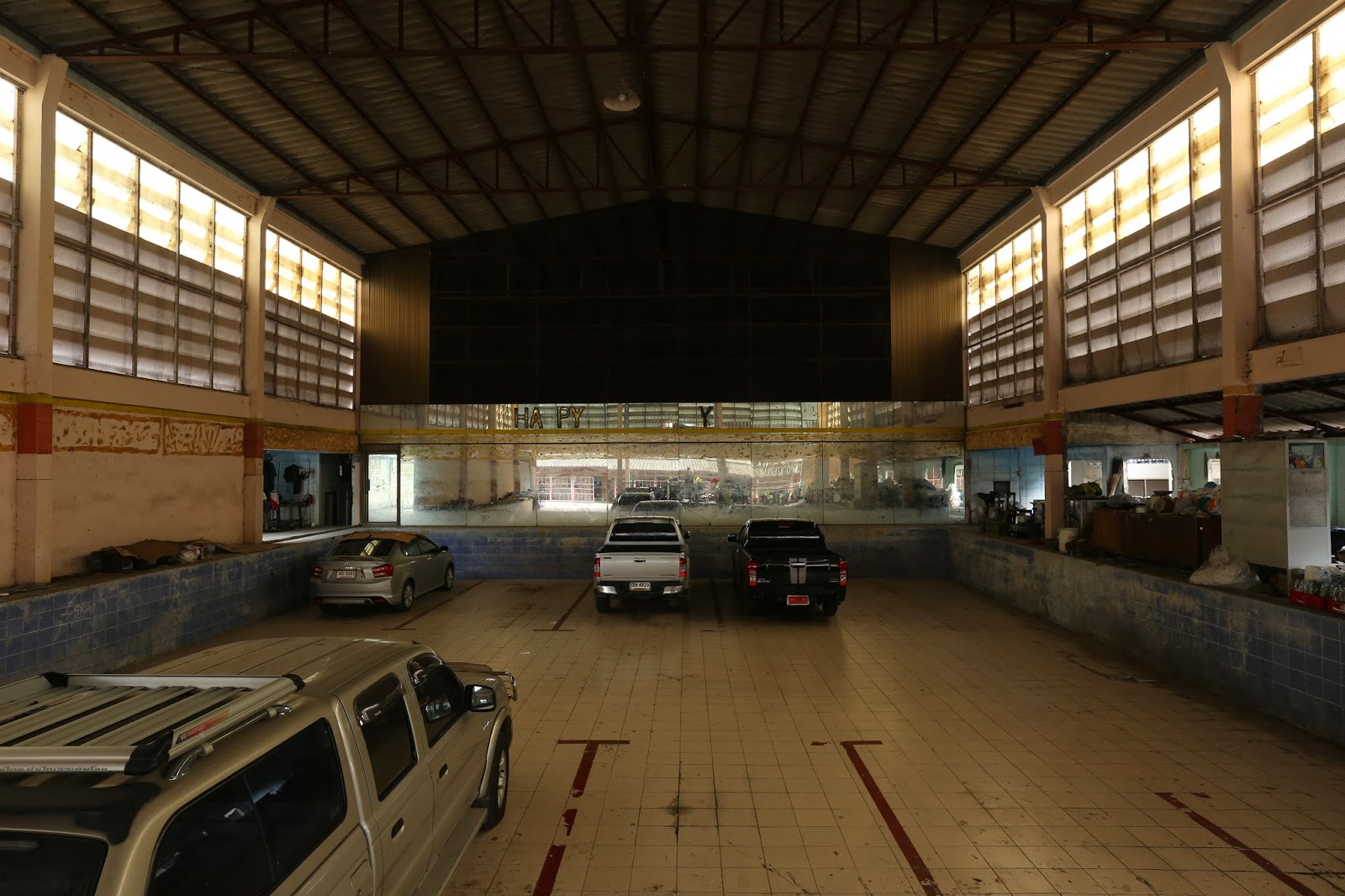
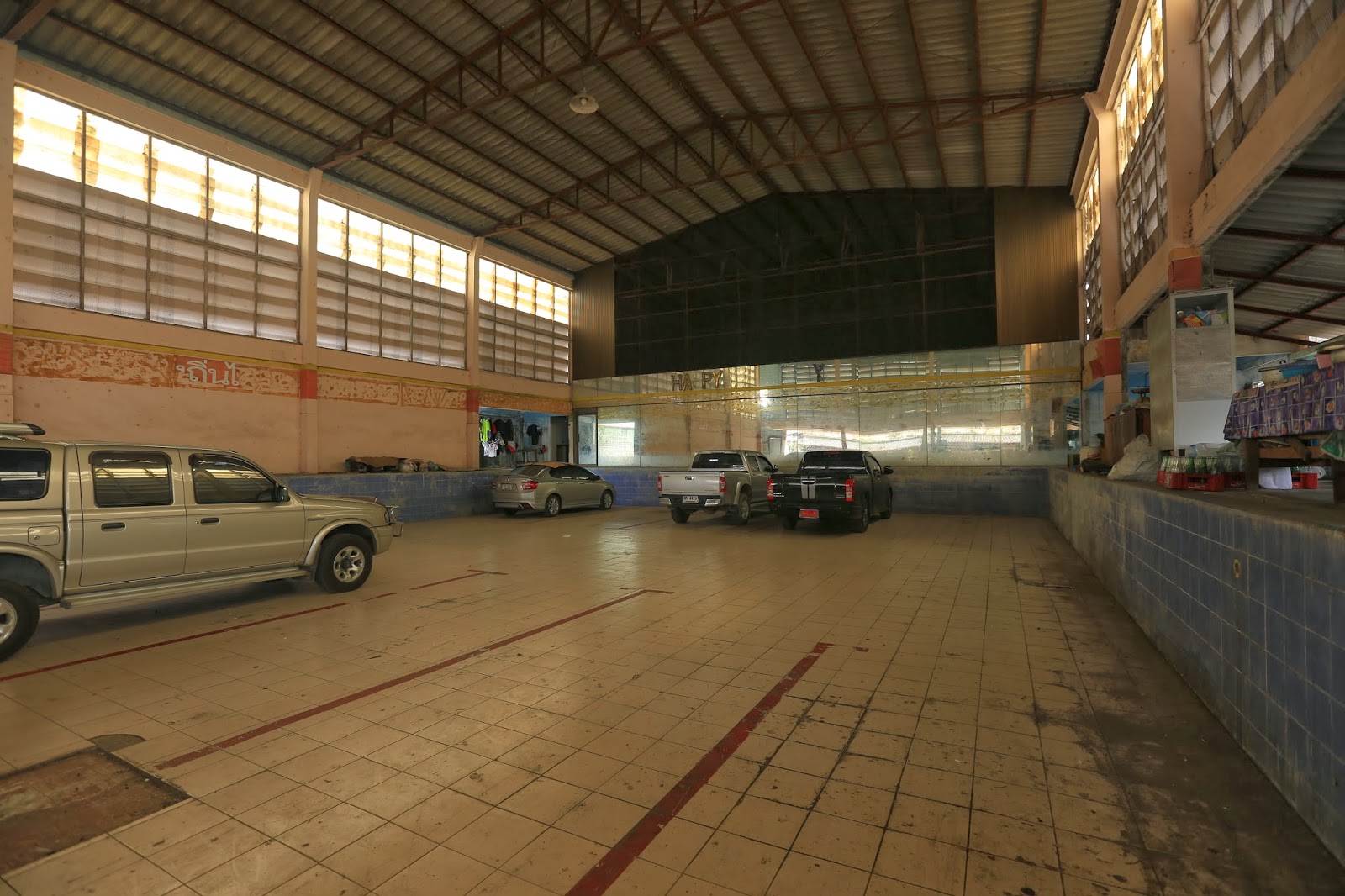
The former Trisuk Theater, now a parking garage and restaurant.

The architectural language of the Trisuk seems to be a play on its name. "Tri" is from the same etymological root as the "tri" in Western languages, meaning three. Add the suffix "suk," in this case meaning happiness or joy, and you get a rough translation meaning "Three Joys." Now look at the architecture of the building. There are three separate pinnacles to it; a central cornice and two wing cornices. The remaining poster case (below), moreover, has a triangulated top. A possible link between name and design?

Admittedly, this observation might be complete conjecture. But on the other hand, there could be a grain of truth to it.   


A leftover from the Trisuk's movie theater days: a frame for movie posters. 

What we do know for certain about the Trisuk was conveyed by a man who helped construct it back in 1973, later on working at the theater as the in-house poster painter. His wife now operates a small restaurant in what was once the theater's lobby.

Despite its original intent, movie exhibition was short lived at the Trisuk Theater. A mere 10 years after its opening, ticket sales had fallen off so much that the theater was gutted and turned into a swimming pool. Its owner, Mr. Somchai Tri-Amnak - whose family name was inspiration for the Trisuk's name - was apparently keen on supplying the good citizens of Khamphaeng Saen with some form of leisure activity. But the swimming pool, too, was unsuccessful.

Next, Tri-Amnak leased the former theater-turned-swimming pool to a supermarket operator. That lasted a while, but ultimately didn't work out. 

In the end the Trisuk was relegated to the lowest possible function that any building can have. Even lower than a latrine. More ignoble than a warehouse of soiled rags. The Trisuk is now a parking garage.


From movie theater, to swimming pool, to supermarket, to parking garage, with a bit of space for a restaurant.

Even in its current low-brow state, one of the more interesting dimensions of the Trisuk is that remnants of all its iterations are plainly visible at once. The mirror on the far wall, for instance, along with the red stripe circumnavigating the wall are leftovers from its supermarket days. 

The blue and white tiles on the lower half of the structure are the pool, basically as it was. 

All the exterior architecture is the Trisuk Theater in seminal form. 


Counter of the restaurant in the lobby.


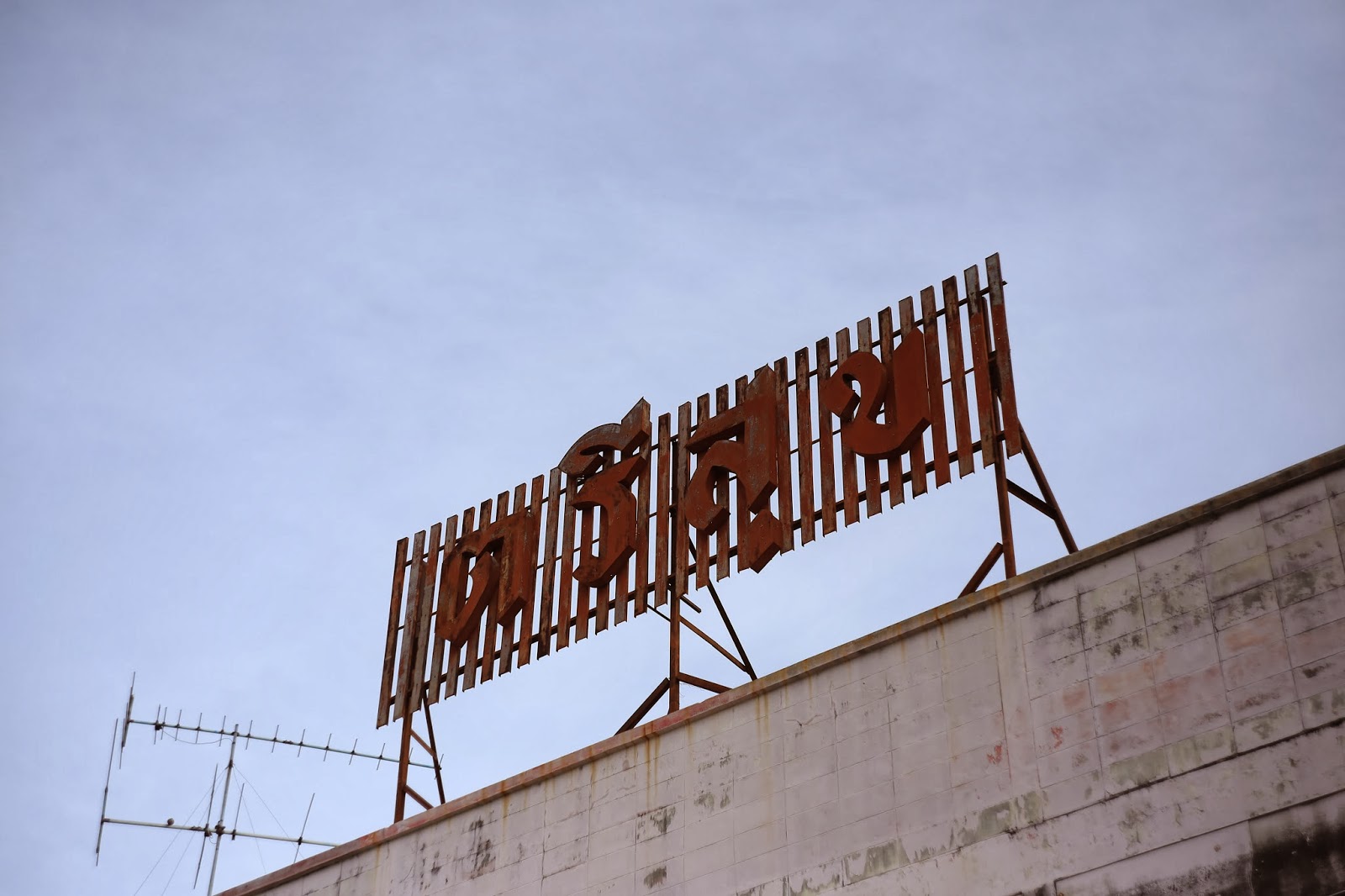
Trisuk signage


It seems unlikely that anything exciting will ever become of the Trisuk. Not in the foreseeable future, anyhow. As it stands now, however, with its exterior architecture in good condition, it gives a little clue as to a more lively past in Khamphaeng Saen. If nothing else, maybe somebody will derive a little inspiration from it.

Thursday, November 21, 2013

The Tang Sia Huad Rama - Nakorn Pathom, Thailand

"It smelled like slow death in there, malaria, nightmares" 

                                                                 - Captain Willard, Apocalypse Now


The third floor of the Tang Sia Huad Rama, once an area reserved for the storage of film reels and other notions of movie exhibition, is now home to festering piles. Anonymous piles, to be sure. Only their amorphous blackness was evident, and that they were inhabited by swarms of fleas that the strays had brought in. Whether the strays were animal or human wasn't immediately clear either.

Nearby shopkeepers in this crumbling quarter of Nakorn Pathom assured me that the cops had chased out the nefarious elements long ago. No more fiends tended to their addictions in the gangrenous warmth of the abandoned cinema. But the fleas. Yes, the fleas reign supreme. No sooner had I planted my feet in preparation for taking a shot than the fleas pounced on my exposed ankles, gorging themselves with reckless abandon.  My speckled legs glowed pink with poison as the fleas advanced higher.

On the far wall of the room, Al Pacino's head, in the role of Officer Frank Serpico, stared back at me from where it had been pasted decades ago. Testament to the theater's illustrious working days. Al - or Frank Serpico, I should say - gazed out mockingly. On second thought, maybe it was a look of pity. Outside the theater, the howls and cries of the local stray brigade could be heard. They were working themselves into a frenzy in advance of the battle they would bring to the invader of their den.             


Frank Serpico overlooks festering piles.


How to exit the cinema without incurring bloodshed quickly became my preoccupation. I doubted the hounds would enter the theater knowing I was inside. That would be too risky for them. It would be a waiting game from here on out. Once I stepped into the light of day, into the weed strewn patch of earth in front of the theater, that's when they would attack. Not in the close quarters of the cinema.

So I swatted the fleas from legs and went to work. As I scanned for decent angles and notable ephemera, I also scanned for objects which could serve as weaponry. There was very little to be found. A rusted knife, some broken chairs. Touching these soiled objects with bare hands seemed just as hazardous as the dogs they were meant to fight off. The best option, it seemed, would be to lock my tripod in its extended position. That four-foot length of titanium would at least allow me to keep them at bay as I moved toward the world of mankind.


In the mid-20th century, Thai movie theaters often employed live voice dubbers to act out the dialogue of foreign films, or Thai films shot without sound on 16mm film. This sign points the way to the Tang Sia Huad Rama's dubber's room.


The descent


Beauty in the bleak


Broken Windows theory.
  
The descent from the third level of the theater was made lengthy by several rounds of long-exposure photography. By the time I had reached the foyer the dogs had grown tired. Most of them had scattered. The two or three that remained by this time were dozing in the weeds. Occupational hazard number one successfully avoided.

Free from fear, the Tang Sia Huad Rama was my oyster. 


Veranda shots. 

As with most Thai theater lobbies, the Tang Sia Huad Rama's is open air, energy efficient and sustainable. Even in decay. 


Buddhist prayer paintings can be seen on the upper part of the door.


The upper sign says "It's forbidden to bring bags of ice into the theater."

According to a local merchant, the Tang Sia Huad Rama and its environs was erected in 1967. Originally, the mixed use commercial/residential development included a covered market as well. But like the theater, that too was long ago left to the dogs. 

The entire development, which covers an enormous swath of land is named for the builder - local business man Mr. Tang Sia Huad. Mr. Tang has since passed away. 

The current owner is the son of Mr. Tang Sia Huad. Generation number two has indeed inherited his father's business acumen, but apparently not the architectural vision. Among his many business ventures at present is licensed dealer for Isuzu vehicles for all of Nakorn Pathom province. By all accounts he's a wealthy man, but not so concerned about his father's built legacy.


The Tang Sia Huad Rama. It's rare to find a Thai theater in which the builder used his original Chinese name as the theater's official name.


Fading colors in a forgotten quarter.


So what accounts for the failure of this zone? Why, despite its centrality, has this been relegated to the status of bypass economy? Merchants and residents claim that it boils down to neglect. Plain and simple. The owner will not sell off the properties individually. Instead he collects rent while being lax on the upkeep.

Speculation is that he's holding out for the right offer from a major retailer, then will sell the entire property off to be redeveloped as hyper-market or shopping mall. Alas, then this community will be no more.


And so will mark the end of the Tang Sia Huad Rama - former centerpiece of entertainment in this forgotten corner of Nakorn Pathom. 

Thursday, February 21, 2013

The Peth Kasem Theater - Nakon Pathom, Thailand (Guest Photos)

The 1997 Asian Financial Crisis was bad for Thailand's independent movie theaters. From the moment of impact, followed by months of downward spiral, scores of already-struggling family movie theaters closed their doors as crowds and access to credit grew scarce. The crisis came to a head because of unregulated speculation in the Thai currency market. When that speculation bubble burst, the financial system collapsed, leaving countless theater operators, with their costly overhead and dwindling attendance, out in the cold. (Of course, the impact went well beyond just theater operators, but for our interests here at the SEA Movie Theater Project, we'll stop at their lament.)

Featured below is the Peth Kasem Theater, a casualty of the '97 crisis located in the Bangkok satellite city of Nakorn Pathom. Like most small Thai cities, many of Nakorn Pathom's locally owned and operated movie theaters closed after the '97 meltdown. Today the structure lives on as a dingy parking garage in a narrow alley, its former luster a thing of the past.


The Peth Kasem Theater once had a seating capacity of 1,200.


Veranda area


What was once the concessions area.


Side doors


Poster of former starlet Jarunee found in upper level.


"Projection room"

It's good fortune that there are a few followers out there who take the time to send in their own movie theater photos. The Peth Kasem is one such submission. These photos come courtesy of a dedicated friend of the Southeast Asia Movie Theater Project, Regis Madec, who's web-site Thai Worldview lists, among other things, numerous Thai film synopses and listings. It's a great resource for those with a yen for Thai cinema.


Thursday, December 6, 2012

Colorful Rot

The ruins of the Tang Sia Huad Rama in Nakorn Pathom are haunting. Why the abandoned theater didn't meet the same fate as the shop houses that once flanked it is unknown. It could be a warehouse, or some other kind of storage facility, I suppose.

Whatever it's post-cinema purpose, I'm glad it's there. And equally glad that my comrade had the consideration to document it and send it this way, to be displayed in the public domain. Colorful rot from central Thailand.