Wednesday, October 8, 2014

The Wiang Mai Theater Revisited

Five years ago, a trip to Mae Sariang and the former Wiang Mai Theater proved only partially fruitful. Long devoid of film, the Wiang Mai had been serving as a propane gas retail center for more than a decade.

Five years ago, a sales woman tending to the business denied access to the sealed theater beyond the lobby. Locked up tight was the order of the day. The big boss, she explained, off in some other part of town tending to his gold mine of a gas station, had no time for riff-raff. She would not ask permission on my behalf.


The Wiang Mai Theater in streetscape context


Black and white by night

A return trip to Mae Sariang this past week was no different. Free reign to photograph the gas tank-filled lobby was welcomed, but yonder auditorium remained off limits. 

"The boss man, he's mean," said the sales woman matter-of-factly. 


5 years ago, not bold enough to seek a higher authority, I was resigned to my meager allowance of access to the theater's lobby. Not much of a concession considering the lobby is a retail business, hence open to the public.  

But now, emboldened by the sweet smell of success, having meticulously transformed myself into Thailand's movie theater mouthpiece, troubadour of forgotten places, I sought out the gas station Godfather at his headquarters.

Upon first impression, I almost wished I hadn't.


Owner of the Wiang Mai Theater Mr. Khamron Aomaree

Enthroned behind a cheap folding table in the store house of his gas station, the boss man lorded over an army of minions, circling about doing this, that and the other. Heavy set and physically imposing - like any good boss man should be - he acknowledged my presence with nothing more than the stone cold stare of a wild west gunslinger. By way of communication, boss man said nothing. But his wide eyed, slightly askance gaze ordered me to state my business or get out.

With his movie theater the stated agenda, boss man gestured for me to sit down. I asked his name, to which he responded by handing me an official document with his name penned in at the bottom. Thai chicken scratch. I couldn't read it.

"Khamron Aomaree" he said at last, finally breaking from his gangster gaze. 

Free of the poker face, the mood lightened and Mr. Aomaree told the saga of his forlorn picture house, before ordering one of his employees to unlock the auditorium for me.


Leftovers from more jovial times.


Gas canisters queued up in front of the ticket windows


Many old theaters contained sound rooms for customers who preferred to watch foreign films in their original language. Tickets for sound rooms were priced slightly higher. Pictured above is the ticket window for the sound room at the Wiang Mai Theater.


Gas tanks in the lobby of the Wiang Mai. 


Auditorium, long sealed shut.

The theater business was a legacy of Khamrom Aomaree's father, who built Mae Sariang's first ever movie theater decades before. As was common for movie theaters in remote areas of Thailand even as late as the 1960's, that original theater was built of wood. Today, wooden movie theaters are an extreme rarity in Thailand. The majority of them were either replaced with concrete theaters by the 1970's, or they were simply demolished and not replaced at all.

The iteration of the Wiang Mai Theater that's standing now was built as an upgrade from the Aomaree's original wooden theater in 1971. About that time, a law was passed in Thailand banning movie theaters built out of wood as potential fire hazards. 


The sound room at the Wiang Mai was a later addition. The room simply enclosed a section of seating on the balcony. The sign on the door advertises it as "air-conditioned room."


Inside the sound room/air-con room. 
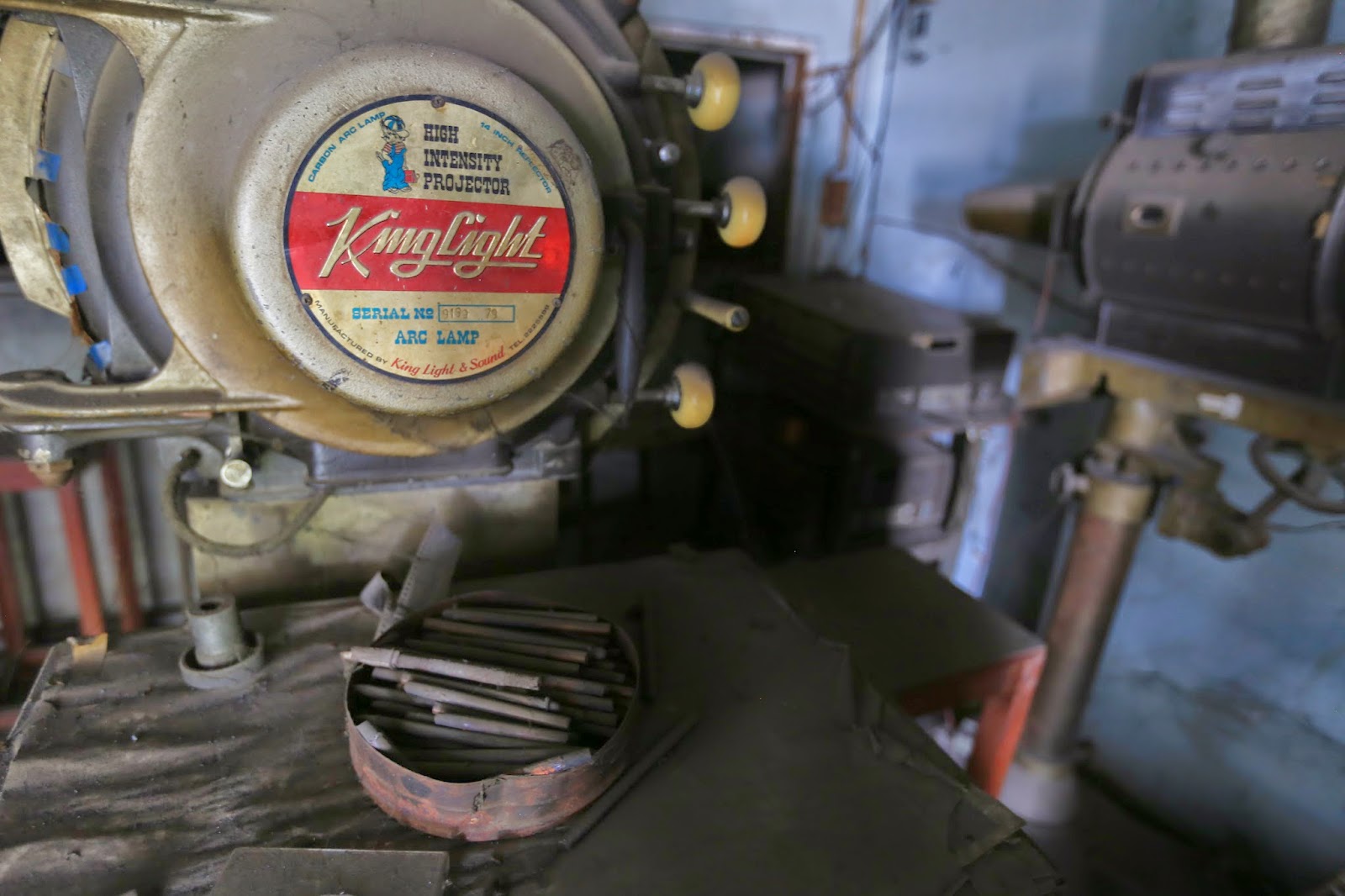

Carbon arc projectors in the projection room. 


Ornamental iron grating on the projection window.


Balcony view


Design details


Khamron held little esteem for the theater business. 

"It was a dishonest business in the old days," he admitted,  referring to the unequal business terms dictated by the movie distribution companies. "I'm glad to be out of it,"

Fortunately, Khamron Aomaree did not get rid of his old white elephant altogether. Today, the Aomaree family legacy stands as reminder to the people of Mae Sariang that, once upon a time, a culture of public entertainment and shared pleasures existed outside of karaoke bars and beer halls.


Tuesday, September 16, 2014

Burma's Silver Screens

My article on Burma's Silver Screens was published in the Democratic Voice of Burma on Sept. 14th, 2014. 


The architectural milieu found in most Burmese cities dates primarily to the mid and early 20th centuries, making it an infrastructural anomaly among its Asean neighbors. This aging-but-architecturally-significant stock of buildings can largely be attributed to the country’s economic isolation over most of the last 25 years. The forces of globalization, in contrast, have led to the constant replacement of aging, “outmoded” structures in most other Asean countries.  

The Waziya Cinema is to undergo renovations
One structure which has endured at a particularly high rate in Burma is the stand-alone movie theater. While stand-alone cinemas in the advanced economies of Southeast Asia have typically found survival under the modernization regime almost impossible, Burmese cinemas have lingered on, even in the face of dwindling attendance. 
Loosening investment policy towards Burma, however, will likely expose these theaters to the whims of the market, where without renewed interest or legal protection, land pressures and lucrative property deals will invariably lead to their destruction. In general, stand-alone movie theaters are one of the first structures to go when redevelopment initiatives are enacted. The large plots they usually occupy make them prime targets in the eyes of developers.

Movie-goers assemble in the lobby of the Nay Pyi Daw Cinema - Mandalay 
Indeed, as this story goes to press, Burmese cinemas are under the greatest duress they have encountered since they became targets for aerial bombardment during World War II. But aside from the buildings themselves, under threat is a unique history which is intimately entwined with that most dynamic of artistic mediums – cinema.The Burmese film industry was once one of Southeast Asia’s most prodigious. In its golden years the creative forces at Rangoon-based studios such as A1, British Burma, New Burma and others churned out thousands of hours worth of celluloid entertainment to meet the needs of a transforming nation.
To accommodate the movie boom, developers, exhibitors and the studios themselves financed the construction of evermore luxurious stand-alone movie theaters.
Between independence from Great Britain in 1947 and the 1962 coup, these temples to cinema were built in record numbers throughout the country. Burma’s staunch position in the Cold War-era Non-Aligned Movement, moreover, ensured that local cinemas were not dominated by films from any one particular country or political alignment, as was common among countries beholden to a single superpower. Burmese theaters instead screened movies from a diverse array of countries, replete with a medley of political messages.

Looking straight down upon movie-goers at the Tun Thiri Cinema - Pyay 
Domestic productions aside, a trip to a cinema hall in the 1950’s could have been spent watching a film from India, China, the Soviet  Union, Singapore, Japan, Britain or, of course, the standard Hollywood fare.This celluloid cosmopolitanism expanded the viewing market. The result was that downtown Rangoon, then the Burmese capitol as well as largest city, became home to a concentration of movie theaters that was unrivaled in Southeast Asia.
Then as it still is today, Rangoon’s movie theater district was centered at the intersection of Sule Pagoda and Bogyoke Aung San roads. At its peak, fourteen cinemas flanked the streets in all 4 directions from that junction alone. Other sections of the city had their own theaters.
Confidence in a prosperous future was high throughout Burma heading in to the 1960’s - a fact evidenced by an increase in construction of all kinds. Cinema design developed into a specialty discipline, as architects combined broader trends in the modern architecture movement with a distinctly Burmese flair.

Arguably Burma's most elegant existing movie theater, the Thamada 
One such design popularized during the period was the “Burmese Polychrome” – one of several iterations of the International Style with a Burmese twist. These theaters feature boxy, quadrangled facades, textured by the use of polychromatic checker patterns. The color variation is achieved through either paint or tile.
Polychromes of Burma


The Shae Saung Cinema - Yangon


The Thida Cinema - Yangon 
The few existing theaters which predate the second World War were elaborate undertakings done in the  Beaux Arts style. Examples of such theaters can be found in the Yangon’s still-active Waziya Cinema and the defunct Cathay Cinema.

The Cathay Cinema - now a rug store.
But the most common architectural form used in Burmese cinema design was Art Deco. The classical symmetry of Burmese Art Deco theaters, often culminating in a central spire, became a distinct physical feature of mid-century urban Burma. If a Burmese city had a movie theater, chances are it was designed in the Art Deco tradition.
Art Deco cinemas of Burma


The Tun Thiri Cinema - Pyay


The Win Cinema - Toungoo


The Khemarat Cinema - Keng Tung
Following the 1962 military coup, the architectural evolution of the movie theater in Burma ceased. Soon after their rise to power, General Ne Win’s government nationalized all movie theaters, putting them under the jurisdiction of the Ministry of Information. From then onwards the few theaters built in the country were state undertakings. In 1984 the Ministry of Construction financed the first of three new theaters in Mandalay – the Myo Gon Yaung – followed by the Myoma and the Nay Pyi Daw. Another, the Nawaday Cinema Garden, was built in Yangon in 1990.

The government-built Myo Gon Yaung Cinema - Mandalay 


The Myoma Cinema, built by the government in 1998
In January 1995, the central government established the Myanmar Privatization Commission (MPC) as a means of selling off some of the nearly 1,800 state-owned enterprises. From its start in 1995 up until 2001, a mere 138 state-enterprises were unloaded, and of those 138, an astounding 87 of them movie theaters.  This statistic has less to do with the investment potential of the cinema business itself as it does the value of the land that cinemas occupy.
Ironically, the stunted pace of development that afflicted Burma for over half a century had a time capsule effect on its cities. Instead of experiencing the large scale restructuring of urban space to accommodate modern industry and its bedfellow, mass consumption – led by the space-requisite automobile – Burmese town and city cores remained comparatively unchanged from their pre-coup conditions. The lack of financial resources to build anew ensured that aging architecture endured, if only out of necessity.
Since Burmese president Thein Sein began the political reform process in 2011, thereby setting the stage for global capital inflows, the country’s stand-alone movie theaters have predictably come under duress. The once vibrant epicenter of movie-going in Rangoon lost four of its remaining nine theaters within a year of reforms. Dozens more have closed their doors across the country, with the spectre of further demolitions steadily on the rise.  And as the number of flashy new multiplex theaters in the country continues to rise, Burma’s stock of ailing stand-alone cinemas will only suffer further.

Security at the Shwe Mann Cinema - Yangon 
Fortunately, there are those in Burma who recognize that good old architecture – movie theater or otherwise – can be an asset worth preserving, rather than a pariah in need of replacement. Leading that charge is the Yangon Heritage Trust – an architectural and cultural heritage advocacy organization established by Dr. Thant Myint Oo. In cooperation with the Myanmar Motion Picture Association, an NGO representing the domestic film industry, they have set a vision for the renovation of the historic Waziya Cinema on Bogyoke Aung San Rd. This will mark the first movie theater preservation initiative in Burma, and one of only a few in all of Southeast Asia.

Monday, September 8, 2014

Khemsawat Cinema Revisited

It was five years ago that the Khemsawat Cinema was first entered into the annals of Southeast Asian movie theater history. At that primeval juncture in the life of this project, raw data on theater's past was unattainable. The parts that made it to print were, admittedly, no more than sensationalist conjectures about a theater in a town infamous for its ties to the dope trade.

This past March, all that circa-2009 speculative drivel was finally laid to rest. The Khemsawat in all its post-cinematic humility was revisited, its current owners interviewed and new light shed on this cinema relic of upper-most Thailand.  


The Khemsawat Cinema - Fang, Chiang Mai Province, Thailand


Unfortunately, the newly acquired "hard data" is pretty dry. There are no reports of forthcoming plans to renovate the Khemsawat and return it to its exalted glory days as Fang's lone movie theater. Most findings were rather sedate. 

But, as is often the case, the research included a distant hopefulness on the part of the owner; a hopefulness which could be the seed of regeneration if the planets align in just the right way.


Stand-alone movie theaters add color and diversity to city streets. 


Night views

A little over a year ago, the Khemsawas Cinema was purchased from its original owner by Sudaphorn Tansuhaj and her husband Ahkom. The couple, who own the adjacent Little Home Resort and several adjoining shophouses, fixed up the theater's lobby just enough so that it could be rented. A Japanese restaurant has since moved in, adding life to what was most recently a dank cave, per se.

The renovations did not entail any structural or otherwise irreversible changes to the space, so should that tiny seed of regeneration ever sprout, the lobby could be easily reclaimed for theatrical purposes.


Bare bones auditorium

The Khemsawat was built in 1975, the first theater in Fang built of brick and mortar. But declining attendance led to it's closure before it would even reach its 30th anniversary. 

On the mezzanine level, the most recent seating type was in the form of bucket seats made of pressed plywood. Older forms of seating were left intermingled, such as a few rows of folding bench seats made of teak, and the original non-folding teak benches. Balcony level seating, presumably higher grade stuffed chairs for those willing to dish out a bit more, had been removed.


Old wooden seats
All this talk of movie theater seats is not unwarranted. In fact, Ms. Sudaphorn made a point of saying that the plywood stock on the lower level was purchased secondhand from a theater owner in Chiang Mai named Loet, last name Shinawatra. That is, father of ousted PM's Thaksin and Yingluck Shinawatra. Indeed, when Loet Shinawatra closed his Sri Visan Theater on Tha Phae Road in downtown Chiang Mai, he sold the seats to the Khemsawat, turning a minor business transaction into an equally minor political footnote from a very unlikely place.

And on that note, of all the Thailand-based alternate histories that are waiting to be written, this is one that begs an author: Had Thaksin Shinawatra and the Shinawatra family's cinema business gone in the same direction as Thailand's other big movie theater families - like the Poonworaluk's (Major Cineplex) and the Thongrompho's (SF Cinema), Thailand as we know it today, flush with political divide, might have never existed.


Pressed plywood seats originally used in a Shinawatra family theater in Chiang Mai.


Signage from behind


Signage from the front

Seat-related intrigues aside, the only other point about the Khemsawat Cinema that's worthy of mention is that ever-so-slight manifestation of hope expressed by Ahkom for his theater's future. In the process of trying to figure out the best use for the now-gutted space, Ahkom explained that he has considered reviving it for arts and entertainment purposes. Chances are slim of that becoming a reality, but the thought alone is a starting point. 

Monday, August 25, 2014

Pecha Kucha Presentation in Bangkok

Tomorrow, for a mere 6 minutes and 40 seconds, I will be preaching the gospel of preservation for Southeast Asia's stand-alone movie theaters. Pecha Kucha is the event. Chulalongkorn University is the backdrop.

If you are in Bangkok, come and hear my sermon. 


In the weeks to follow, there will be fresh new images and stories from the forgotten corners of Southeast Asian popular culture. And I promise to dig deeper than ever before. 

Friday, August 15, 2014

Thai Film Archive activates Scala and Lido

This past week,Thailand's two most iconic film venues - the Scala and Lido theaters - showcased a cultural event that only an iconic film venue can adequately showcase. 


The Scala hosting Alfred Hitchcock's "The Lodger"

From August 7th to the 13th, the Thai Film Archive hosted Thailand's first ever silent film festival. In collaboration with the British Council of Thailand, the Thai Film Archive, led by chief archivist Dome Sukwong, curated a program that consisted 7 films from Asia and Europe. All films were accompanied by live musical performances, much the way silent films were presented in the early 20th century. 

The grand finale of the festival was a screening of Alfred Hitchcock's 1927 masterpiece, "The Lodger," with a magnificent score provided my pianist Trisdee na Patalung. 

The decision to hold this unique festival at the legendary Apex theaters of Siam Square, coupled with the fact that each showing had near-capacity crowds, ought to be an indication of the intrinsic cultural value of both Scala and Lido. They are much more than just venues for entertainment. They are icons of cultivated sophistication. Indeed, if the motto of the Thai Film Archive is true, that "Cinema Enlightens," then the Scala and Lido are houses of enlightenment. 

Proposals to demolish either Scala or Lido to make room for shopping malls, as has been in the planning stages for more than two years, would be an error of judgement on the part of Bangkok civic leaders. In short it would be a net loss for the Thai capital, if not Thailand as a whole. 

Below are a few shots of the Scala during the final night of the festival.


Filling the Scala


Friday, July 18, 2014

Memoirs of a Movie Theater Maestro

Mr. Chalong Praditsuwan stood out in my mind as one of the more thoughtful characters I had encountered while researching Thailand's stand-alone movie theaters. Having once been at the helm of entertainment in his home town of Taphan Hin, Phichit, Chalong knew all the ins and outs of the movie industry in Thailand, past and present, including the societal shifts that had rendered his business lifeless.

He was also in possession of one of the most affable personalities out there, a trait, I surmised, that would lend itself exactingly to the making of a short documentary about Thailand's movie-going past.

A return visit to his movie theater-turned-private home after more than four years proved me correct. Here's the outcome of that meeting.

Saturday, July 12, 2014

"The Architecture of Dreams" Part 2

"I've always loved movie theater architecture. Well, maybe not always, but at least since the early 80's. Since I bought "Architectures de Cinemas," by Francis Lacloche (Editions du Moniteur, 1981). In those days I was living in Paris, working in some architectural office, I saw many old cinemas closing down one after the other. I got myself some old 1960's movie programs and spent many weekends looking for these lost, closed-down-but-maybe-still-there cinemas anywhere I went. I was feeling like some kind of urban archaeologist, trying to find a forgotten Egyptian temple in a deserted suburban street.
Then came 1990, and for some reason I had the opportunity to quit my job, my flat and everything, and spend a long time travelling around the world. I came back 8 months later with a suitcase foll of sketch books, souvenirs and slides. Cinema slides, of course.
There are kinds of cinemas, but you can always recognize a movie theater anywhere in the world, even without any movie posters of the facade. Why? Because they all have something special. Something about adventures, love, fantasy. Something about dreams. It's the architecture of dreams."
Philippe Doro
www.philippedoro.com

The Cinemas of Thailand


The Saeng Tawan Theater, Chiang Mai, Thailand


The Tippanetr Rama, Chiang Mai, Thailand


The Hong Rama, Sukhothai, Thailand


The Malai Rama - Lopburi, Thailand


Marquee of the Chalerm Rath Theater - Khon Kaen, Thailand


The Sala Chalerm Krung - Bangkok, Thailand


The Paradise Theater - Bangkok, Thailand


The Capitol Theater - Bangkok, Thailand


Hat Yai Plaza - Hat Yai, Songkla Province, Thailand